
How a non-transparent online questionnaire was transformed into a national mandate through selective framing, unchecked self-selection, and undisclosed controls.
Hossein Saiedian, Ph.D. and Kazem Kazerounian, Ph.D.
GAMAAN’s survey on the 2026 protests and the 39-Day War presents itself as a large-scale measure of opinion inside Iran. A close examination of its technical design, sampling pathway, undisclosed controls, demographic imbalance, and politically selective interpretation shows something very different: a nontransparent online exercise whose findings are repeatedly arranged to promote monarchy, elevate Reza Pahlavi, legitimize external military pressure, and marginalize rival opposition forces.
A Political Conclusion Disguised as Measurement
On July 27, 2026, the GAMAAN Institute published a report titled “Iranians’ Attitudes toward the 2026 Protests and the 39-Day War.” The report claimed that its online questionnaire had been completed by more than 33,000 people during a seven-day period, from June 20 to June 27. After incomplete, inconsistent, or invalid entries were removed, GAMAAN attributed 31,450 responses to residents inside Iran. After weighting, it reported an effective sample size of 6,211.
Those figures give the appearance of scale, precision, and scientific authority. Nevertheless, a large number displayed in a report is not the same thing as a verified number of independent human respondents. GAMAAN has not publicly demonstrated that the 31,450 retained records corresponded to 31,450 distinct individuals. Nor has it provided the technical evidence needed to reconstruct how the initial pool of “more than 33,000” submissions became the final inside-Iran dataset. The exact starting number was not disclosed. There is no public accounting of how many people opened the survey, how many began it, how many completed it, how many entries came from abroad, how many were duplicates, how many appeared automated or coordinated, and precisely which rules were used to exclude them.
GAMAAN’s survey on the 2026 protests and the 39-Day War presents itself as a large-scale measure of opinion inside Iran. A close examination of its technical design, sampling pathway, undisclosed controls, demographic imbalance, and politically selective interpretation shows something very different: a nontransparent online exercise whose findings are repeatedly arranged to promote monarchy, elevate Reza Pahlavi, legitimize external military pressure, and marginalize rival opposition forces.
A Political Conclusion Disguised as Measurement
On July 27, 2026, the GAMAAN Institute published a report titled “Iranians’ Attitudes toward the 2026 Protests and the 39-Day War.” The report claimed that its online questionnaire had been completed by more than 33,000 people during a seven-day period, from June 20 to June 27. After incomplete, inconsistent, or invalid entries were removed, GAMAAN attributed 31,450 responses to residents inside Iran. After weighting, it reported an effective sample size of 6,211.
Those figures give the appearance of scale, precision, and scientific authority. Nevertheless, a large number displayed in a report is not the same thing as a verified number of independent human respondents. GAMAAN has not publicly demonstrated that the 31,450 retained records corresponded to 31,450 distinct individuals. Nor has it provided the technical evidence needed to reconstruct how the initial pool of “more than 33,000” submissions became the final inside-Iran dataset. The exact starting number was not disclosed. There is no public accounting of how many people opened the survey, how many began it, how many completed it, how many entries came from abroad, how many were duplicates, how many appeared automated or coordinated, and precisely which rules were used to exclude them.
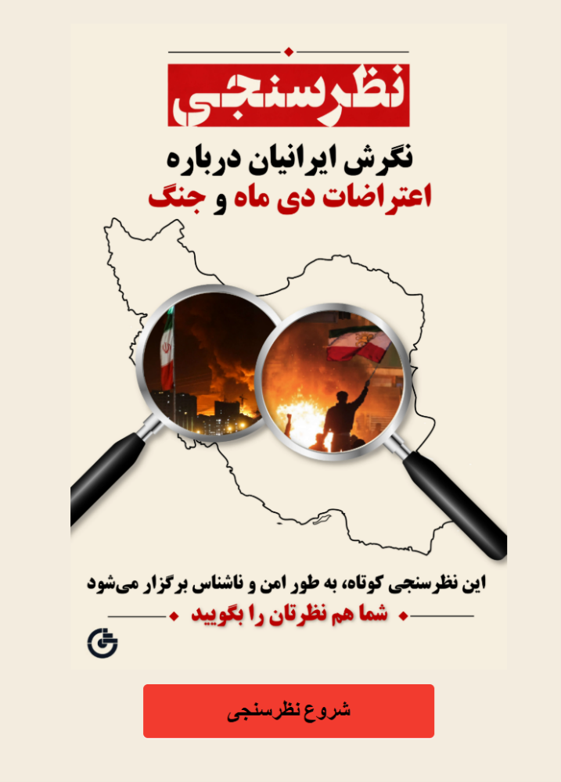
Above: English translation of the banner text: “Survey”; “Iranians’ views on the Dey protests and the war”; “This short survey is conducted securely and anonymously”; “You too, share your opinion”; “Start Survey”.
The prominence of Psiphon creates a misleading aura of external validation. Psiphon displayed the banner, but it did not administer the questionnaire. It did not determine whether one person could respond repeatedly. It did not verify the identity or residence of participants. It did not screen the dataset, remove suspicious records, apply weights, calculate findings, or interpret the political meaning of the answers. The survey itself was hosted on Crowdsignal, and the relevant controls remained with the survey administrator.
No public statistics were provided on the number of banner impressions, unique users who saw the invitation, clicks, questionnaire starts, completions, or the conversion rate from exposure to submission. Without those figures, readers cannot know whether respondents represented a broad cross-section of invited users or a small, highly motivated faction that self-selected into a political questionnaire. Psiphon’s large user base cannot be treated as the survey’s sample frame when there is no disclosed denominator and no evidence that every user had a known, nonzero, and comparable probability of selection.
The distinction is decisive. Psiphon can credibly establish only that it was a distribution channel. Its name cannot authenticate GAMAAN’s final count, its anti-duplication procedures, or its conclusions. Treating the platform that carried an advertisement as a guarantor of the resulting research is equivalent to treating a newspaper as the auditor of every questionnaire advertised on its pages.
The Crowdsignal Black Box
The questionnaire was hosted on Crowdsignal, a platform that allows survey administrators to activate or deactivate controls such as one response per computer, anti-bot testing, email verification, passwords, access restrictions, and restricted or one-time links. Those settings matter because they help determine whether a recorded submission is likely to represent a separate respondent or merely another entry created by someone who has already participated.
GAMAAN stated that it used a control question to detect random or bot-generated responses and that it removed incomplete or inconsistent submissions. But it did not disclose whether the “one response per computer” restriction was active. It did not explain whether duplicates were identified through a computer, browser, cookie, IP address, email address, device signature, completion pattern, or some other method. It did not report how many duplicate or suspicious entries were found. It did not publish the settings in force during fieldwork, a technical audit log, the screening code, or a sufficiently detailed flow table showing the disposition of every category of submission.
If the one-response restriction was not enabled, the same person could technically have completed the questionnaire again from the same computer after submitting it. That person could potentially have generated dozens of separate records. If the restriction was enabled, the problem would not disappear. A computer is not a human identity. One person can use multiple computers, phones, browsers, profiles, or technical environments. Conversely, several people can share a device. A device-level restriction can reduce one type of duplication, but it cannot establish that every retained record belongs to a unique individual.
The problem is that GAMAAN has not released the evidence required to rule it out. A politically consequential survey cannot ask the public to infer integrity from undisclosed settings controlled by the same institution that publishes the desired political interpretation. Transparency is not an optional courtesy in such a case; it is the minimum condition for treating the numbers as evidence.
How a Small Organized Network Could Distort a Large Sample
The vulnerability becomes easier to understand when expressed numerically. If 100 organized participants each submitted the questionnaire 20 times, they would create 2,000 records, equal to approximately 6.4 percent of the reported final sample. If those same 100 people submitted 50 responses each, they would generate 5,000 records, or about 15.9 percent of the sample. If each submitted 100 times, they would create 10,000 records, nearly one-third of the announced total.
These examples do not prove that such an operation occurred. They demonstrate why disclosure of duplicate controls, timestamps, device patterns, response bursts, and suspicious clusters was indispensable. A sample of 31,450 appears impressive only if the records can be tied with reasonable confidence to independent respondents. In the absence of an audit, a very large count can magnify rather than solve the credibility problem. It creates an illusion of certainty while concealing how little is known about the people behind the entries.
GAMAAN has not publicly shown how it tested for concentrated activity, unusually rapid completions, repeated answer sequences, submissions from similar technical environments, or abrupt surges in participation. It has not stated how many records were removed for coordinated behavior. It has not made the raw data and filtering process available to an independent body capable of reproducing the final count. The public is therefore left with a number that is exact to the last digit but unsupported by an equally exact chain of custody.
Residence Inside Iran Was Self-Declared, Not Verified
GAMAAN acknowledged that people both inside and outside Iran completed the questionnaire. It nevertheless attributed the overwhelming majority of retained responses to residents inside the country. The supplied analysis states that the final report treated about 99 percent of respondents as inside Iran, but it did not explain how that status was independently verified. Residence appears to have depended substantially on what participants entered about themselves.
That is particularly important because approximately 97 percent of respondents reached Crowdsignal through Psiphon. When a user connects through the Psiphon tunnel, the survey platform may see an exit-network address rather than the user’s actual location. The information entered in the questionnaire—country, city, or province—therefore becomes crucial, yet self-declaration alone cannot establish residence. A person located in London, Los Angeles, Paris, or elsewhere could select Tehran, Isfahan, or another Iranian location.
Again, the point is not to assert without evidence that every location claim was false. It is that the technical pathway made independent location verification difficult, while GAMAAN did not publish a method capable of resolving the problem. Nor did it disclose the number of submissions received from outside Iran, the number rejected because of a mismatch between claimed and observable location, or the number excluded for suspicious geographic patterns. Without that information, “inside Iran” is an administrative label assigned within GAMAAN’s own process, not an independently demonstrated fact about each respondent.
A Self-Selected Audience Is Not the Iranian Population
Even if every retained submission came from a real, unique person who genuinely lived inside Iran, the survey would still not constitute a random sample of the Iranian public. Participation required a specific sequence of conditions. A person needed internet access, had to use Psiphon, MahsaNet, or Lantern during the seven-day field period, had to notice the banner, had to choose to click it, and then had to volunteer answers to a political questionnaire.
Every stage selected for particular kinds of respondents. People without stable internet access had little or no chance of inclusion. Users of other circumvention tools were outside the main recruitment pathway. People who avoided political questionnaires because of fear, distrust, fatigue, or privacy concerns were less likely to participate. Rural residents, economically disadvantaged communities, less technically connected groups, and citizens who did not regularly use the featured tools had fewer opportunities to enter the sample. At the same time, politically engaged users with strong views and a willingness to answer were more likely to respond.
The raw demographics reported in the supplied material expose the depth of the imbalance. More than 77 percent of the unweighted sample was male. More than 95 percent was urban. Nearly 68 percent had a university education. People aged 15 to 29 accounted for only about 8 percent. This was not a miniature Iran. It was a heavily skewed pool dominated by male, urban, educated internet users who opted into a political survey through a narrow set of circumvention platforms.
That selection mechanism matters because political attitudes are not randomly distributed across access, education, place of residence, age, gender, digital behavior, and willingness to answer sensitive questions. A self-selected online audience may reveal what that audience thinks. It cannot simply be relabeled as the opinion of a nation.
Weighting Cannot Manufacture Representativeness
GAMAAN attempted to correct the demographic imbalance through extensive weighting. The reported effective sample size fell from 31,450 records to 6,211 after weighting. That reduction itself signals how unequal the statistical influence of individual responses became. Some categories had to be down-weighted heavily because they were overrepresented, while underrepresented categories had to carry far more influence than their raw numbers would otherwise justify.
Weighting can adjust known variables when the underlying sample has a defensible relationship to the target population and when relevant groups are present in sufficient numbers. It cannot transform a voluntary, nonprobability sample into a random national sample merely by matching selected demographic margins. It cannot supply the opinions of people who were never reached. It cannot correct for political self-selection when willingness to participate is itself connected to the answers. It cannot determine whether respondents are unique. It cannot verify residence. It cannot repair undisclosed duplicate controls or unknown response rates.
The effective sample size of 6,211 is therefore not a certificate of representativeness. It is the statistical residue of an attempt to compensate for a deeply unbalanced intake. The more the raw sample differs from the population, the more the final estimates depend on modeling decisions made by the survey administrator. Without raw data, weighting specifications, sensitivity tests, and independent replication, readers cannot know how robust the headline percentages are to alternative assumptions.
The Questionnaire’s Political Architecture
The technical weaknesses would be serious in any survey. They become politically explosive when considered alongside the content chosen for measurement and the way the findings were framed. The questionnaire assembled questions about war, protests, slogans, flags, forms of government, political personalities, and opposition groups. That breadth can create an appearance of comprehensive inquiry. Yet the reported results repeatedly assemble these subjects into a single restorationist storyline.
GAMAAN reported that about 67 percent agreed with the slogan “Reza Shah, rest in peace,” while more than half supported “Long Live the Shah.” It highlighted preference for the Lion and Sun emblem in a manner that encouraged readers to treat a historical national symbol as evidence of support for monarchy or for the Pahlavi family. It emphasized a figure of 34 percent for different forms of monarchy, even though 34 percent is not a majority. The number was nevertheless positioned as evidence that monarchy was the leading or expanding political alternative.
This is how opinion engineering can operate. The questionnaire defines the menu of subjects. The response options define the boundaries of political meaning. The report then selects which numbers to foreground, which comparisons to minimize, and which interpretation to repeat. A historical symbol becomes a monarchist vote. Approval of a slogan becomes a constitutional preference. A plurality is presented with the emotional force of a majority. Separate attitudes are woven into a claim that the country is moving toward restoration.
The Lion and Sun example is especially revealing. Support for that emblem does not logically require support for a king, hereditary rule, Reza Pahlavi, or the restoration of the former dynasty. Treating those positions as interchangeable collapses national symbolism into partisan branding. The survey’s interpretation effectively claims ownership of a broad Iranian historical symbol on behalf of one political current.
Reza Pahlavi Was the Survey’s Real Center of Gravity
The most consistent beneficiary of the report’s framing is Reza Pahlavi. GAMAAN reported that 45.2 percent held a positive view of him both before and after the war, while 3.2 percent moved from a negative to a positive view.
The more dramatic claim was that about 55 percent of respondents who had participated in protests identified Reza Pahlavi’s call as one reason for their presence. That number does far more than measure favorability. It implicitly casts him as a mobilizing leader of events inside Iran. Yet the claim rests on the same nontransparent, self-selected, demographically distorted sample whose respondent identities, locations, and duplication controls cannot be independently audited.
Without the raw data, the exact wording and ordering effects, the screening rules, and independent verification, the figure cannot carry the political weight assigned to it. It does not independently establish who mobilized protesters in the streets. It records what a selected online group said in a questionnaire administered and interpreted through an opaque process. Presenting it as evidence of national leadership converts methodological uncertainty into political capital.
War, Foreign Pressure, and a Manufactured Mandate
The treatment of war follows the same pattern. The supplied analysis states that roughly 40 percent characterized military operations by the United States and Israel as a form of “humanitarian intervention.” It also states that 68 percent regarded an agreement as contrary to the interests of the Iranian people. Placed side by side, these findings can be used to suggest that a large portion of society rejects accommodation, accepts continued confrontation, and validates the foreign-policy positions associated with Reza Pahlavi.
However, the conclusions do not logically follow. Opposition to a particular agreement is not identical to support for war. Hostility toward the Islamic Republic is not consent to bombing. Approval of pressure is not approval of every military operation. Nor does rejection of the current regime imply a desire to replace it with a restored monarchy. These are separate political judgments, and a credible survey must preserve rather than erase the distinctions among them.
The reported framing blurs those boundaries. Dissatisfaction with the Islamic Republic is converted into implied acceptance of outside military action. Opposition to an agreement is transformed into an appetite for escalation. Those attitudes are then placed beside pro-Pahlavi results, allowing the reader to infer a unified national mandate that the survey itself has not established. The political usefulness of the arrangement is obvious: it portrays monarchist positions on external pressure not as the choices of one faction, but as the measurable will of Iranians inside the country.
Slogans as Weapons Against Political Rivals
The survey’s slogan section also reveals a partisan design. It included “Death to the three corrupt: the mullahs, the leftists, and the Mojahedin,” a slogan directed not only against the ruling clergy but also against two categories of political rivals to monarchism. It was placed alongside “Death to the oppressor, whether Shah or Leader,” a slogan that rejects both monarchical and clerical dictatorship.
These are not parallel propositions. The second is an anti-dictatorship formula that denies legitimacy to both systems. The first is an exclusionary attack that groups the current rulers with leftists and the Mojahedin and marks all three as enemies. Presenting the two as comparable items does not neutrally map public language. It normalizes a monarchist slogan aimed at delegitimizing competing opposition forces while weakening the political significance of a slogan that rejects both the Shah and the Supreme Leader.
The choice to include, compare, and publicize such slogans helps define the political field before the answers are even counted. It places monarchist language inside the category of legitimate national expression and frames rivals as objects of popular rejection. Combined with the questions on monarchy, the Lion and Sun, pro-Shah slogans, Reza Pahlavi’s favorability, his alleged role in protest mobilization, war, and external intervention, the pattern is too coherent to dismiss as accidental.
What GAMAAN Would Need to Disclose
A survey making claims of this magnitude should be independently reproducible. At minimum, GAMAAN would need to publish the exact number of questionnaires opened, started, completed, rejected, and retained; the number of banner views and unique clicks on each distribution channel; and the completion and response rates. It would need to disclose the Crowdsignal settings used during fieldwork, including whether one response per computer was active, which anti-bot measures were enabled, and whether passwords, email verification, restricted links, cookies, or other controls were used.
It would also need to explain precisely how duplicate responses were detected, how many were removed, how suspicious or coordinated activity was defined, and how many records were excluded for those reasons. It would need to document how residence inside Iran was established despite the use of circumvention tunnels, how discrepancies between declared and observable location were handled, and how many outside-Iran responses entered and exited the dataset.
Finally, GAMAAN would need to release the raw or suitably anonymized data, the complete questionnaire with wording and order, the cleaning code, the weighting model, the population benchmarks, and sensitivity analyses showing how the principal political findings change under alternative assumptions. These materials should be provided to an independent auditor with no role in designing, administering, or promoting the survey. Until that happens, the report’s most consequential claims remain assertions produced inside a system that GAMAAN itself controlled from recruitment through interpretation.