Institutional Author and Publisher: Free Iran Scholars Network (FISN)
Publication Date: 25 October 2026 | Research Cutoff: 25 October 2026
Suggested Citation: Free Iran Scholars Network. (2026). Political intimidation and democratic participation in the Iranian diaspora: Leadership accountability and exclusionary politics in the Pahlavi network (Research report, Version 4.0, October 25). FISN.
Abstract
This research report examines political intimidation associated with identifiable pro-Pahlavi actors in the Iranian diaspora . It asks three questions: what the available evidence establishes about leadership knowledge and accountability; how exclusionary rhetoric and SAVAK symbolism operate within the political network; and how reported intimidation affects political participation and public representation . The study draws on a purposive collection of reporting, public statements, documentary materials, witness testimonies, interviews, and court and police records, with coverage through 25 October 2026 . It distinguishes directly reviewed records from documents described by journalists and separates allegations from adjudicated findings .
The material documents recurring reports of threats, harassment, disruption, online targeting, and physical confrontation across several countries . Some affected individuals describe withdrawing from public activity or taking additional protective measures . These accounts identify specific costs to political participation and raise concerns about strategic tolerance of intimidation . The paper examines this interpretation alongside competing explanations .
Reza Pahlavi’s public statements include condemnations of violence and a promise of stricter protocols . Evidence of implementation and enforcement remains insufficient to determine whether these commitments have produced meaningful accountability or primarily served to distance his leadership from misconduct .
The concern extends beyond rhetoric . Pahlavi’s published plan for governing Iran after the fall of the Islamic Republic formalizes concentrated, unelected authority alongside stated electoral and procedural safeguards whose independence and enforceability require scrutiny . Read alongside his responses to reported intimidation, the plan reinforces FISN’s assessment that tolerance of pressure against critics is consistent with his proposed approach to governing .
The paper offers institutional recommendations for media, universities, and think tanks . Broader effects on opposition cooperation, public representation, and political advantage for the Islamic Republic remain hypotheses requiring further research .
Disclosures and Organizational Position
Free Iran Scholars Network (FISN) opposes restoration of the Pahlavi monarchy and supports a democratic republic in Iran . These commitments are disclosed because they bear on the selection and interpretation of this study’s subject .
The immediate impetus was the confrontation at the New York gathering on 22 September 2026 . FISN members report witnessing harassment, threats, and an assault . Their presence supplies relevant testimony but also creates a need for transparent corroboration and careful separation of observation from interpretation . Section 5 records the episode as an allegation supported by participant reporting, not as an adjudicated offense . The draft’s reported arrest and docket details require confirmation from the court record before a definitive account of the proceedings can be published .1
Throughout, a witness description is an account of what a person says they observed; an allegation is a claim not established by a relevant adjudication; a charge is a formal accusation; a procedural ruling resolves the issue before the court; and an adjudicated fact is a finding within the scope of that decision . None of these categories automatically establishes a political leader’s responsibility for another person’s conduct .
Introduction and Research Argument
An opposition’s democratic claims can be tested through the treatment of people who reject its leaders or preferred constitutional settlement . The relevant freedoms include criticism, independent organizing, and peaceful assembly . When exercising those freedoms brings threats or retaliation, the immediate question is what happened, who was responsible, and how people with influence responded . Such conduct raises questions about leadership and democratic accountability regardless of whether it results in criminal liability .
This paper uses “Pahlavi network” as a relational description, not the name of a single organization . It includes Reza Pahlavi; family members acting publicly in his political cause; people credibly identified as advisers or organizational representatives; and self-identified supporters whose conduct is examined in specific records . These relationships differ materially . A public advisory role establishes closer proximity than a slogan, photograph, or self-description . A claimed affiliation alone does not establish authorization, command, funding, or operational control . However, where identifiable advisers are implicated in reported conduct, the inquiry extends beyond self-described supporters to individuals with closer ties to Pahlavi’s leadership . Their roles and actions warrant scrutiny, alongside evidence of his knowledge and response .
“Neo-Pahlavism” refers here to a political current centered on Reza Pahlavi that treats allegiance to him as a test of national loyalty and rehabilitates aspects of the former monarchy to justify his present claim to political authority . The analysis focuses on this current, not monarchists as a whole, whose shifting factions and alliances include voices that have publicly opposed neo-Pahlavism . The term applies to observable rhetoric and conduct, not to an assumed psychological disposition or a uniform membership category .
The argument connects two questions: how dissent is treated today and how it would be protected under Pahlavi’s proposed transition plan . Documented incidents and public messages inform the assessment of leadership accountability; the plan shows how power would be allocated and constrained . Read together, they help assess whether current political practices align with the proposed approach to governing . Neither substitute for evidence about the other: the plan does not establish responsibility for an attack, and a supporter’s misconduct alone does not establish how a future government would operate .
Our inquiry preserves three research questions :
- Question 1 (Leadership accountability): What do Pahlavi’s responses reveal about his democratic leadership, and what evidence distinguishes limited influence, dependence on associates, selective enforcement, and tacit tolerance?
- Question 2 (Ideology and network influence): How do exclusionary slogans, SAVAK glorification, and demands for loyalty reinforce intimidation, and what roles do key advisers play in promoting or legitimizing these practices?
- Question 3 (Democratic participation and representation): How does intimidation constrain diaspora participation, raise the costs of advocacy, and distort the public representation of democratic alternatives before international policymakers?
The public record permits more specific criticism of particular messages than of the network as a whole . The examples examined here include posts by Pahlavi’s wife, Yasmine Pahlavi, and his most senior advisors: Saeed Ghasseminejad and Amir Etemadi . More specifically, the example includes Yasmine Pahlavi’s repost of a death slogan directed at political opponents, Saeed Ghasseminejad’s binary framing of political allegiance, and a threatening statement attributed to Amir Etemadi .
Finally, the paper examines whether intimidation and fear of retaliation discourage activists from working across political differences, weaken trust within the diaspora, and divert attention from repression in Iran and democratic alternatives toward diaspora conflict . Such fragmentation could benefit the regime in Tehran, whether or not the conduct is coordinated with it . This is a question about political effect; it is not a claim that Tehran directed the conduct .
Methodology and Evidentiary Boundaries
This is a qualitative case study based on purposively retrieved material, not a representative survey or exhaustive incident census . The contemporary registry concerns material reported between January and October 2026, with a collection cutoff of 25 October 2026 . Earlier material is used only for relevant organizational, legal, and historical context .
The source corpus includes English, Farsi, and German material, with a Swedish interview examined in its published form . Searches combine personal and organizational names with incident locations and terms relating to threats, harassment, assault, disruption, SAVAK, and leadership responses .
Leadership Accountability
3.1 The Reuters Interview and the Response to Allegations
Reuters interviewed Reza Pahlavi in Paris on 14 July 2026; its published interview appeared on 28 July . The recording and transcript are the primary sources for Pahlavi’s answers . Specific allegations placed before him establish notification at that interview, not prior knowledge, the truth of every allegation, or his control over alleged perpetrators .
His responses included condemnation of violence, a demand for legal accountability, and the suggestion that some perpetrators might be provocateurs rather than genuine supporters . Asked about associates’ rhetoric including the post by his wife, Yasmine, and Saeed Ghasseminejad’s binary framing of political allegiance, he said he had spoken to them and was introducing stricter protocols . He also invoked their frustration and freedom of speech . These answers are counterevidence to a claim of unqualified public endorsement . They leave open whether the announced measures had clear rules, enforcement, or effects . The relevant passages begin around 12:01, 13:06, and 15:20 in the Reuters recording .
The strongest accountability question concerns identifiable associates over whom leadership may have greater influence than over an unaffiliated demonstrator . The supplied screenshot of Saeed Ghasseminejad’s 25 January 2026 post frames support for Pahlavi and support for the Islamic Republic as the available alternatives . It describes people weakening the “field commander” as enemy agents . Reuters put the post to Pahlavi and reported Ghasseminejad’s explanation that he meant a small monarchist faction opposed to a referendum . Figure 1 reproduces the Persian screenshot; its original permalink remains to be supplied .
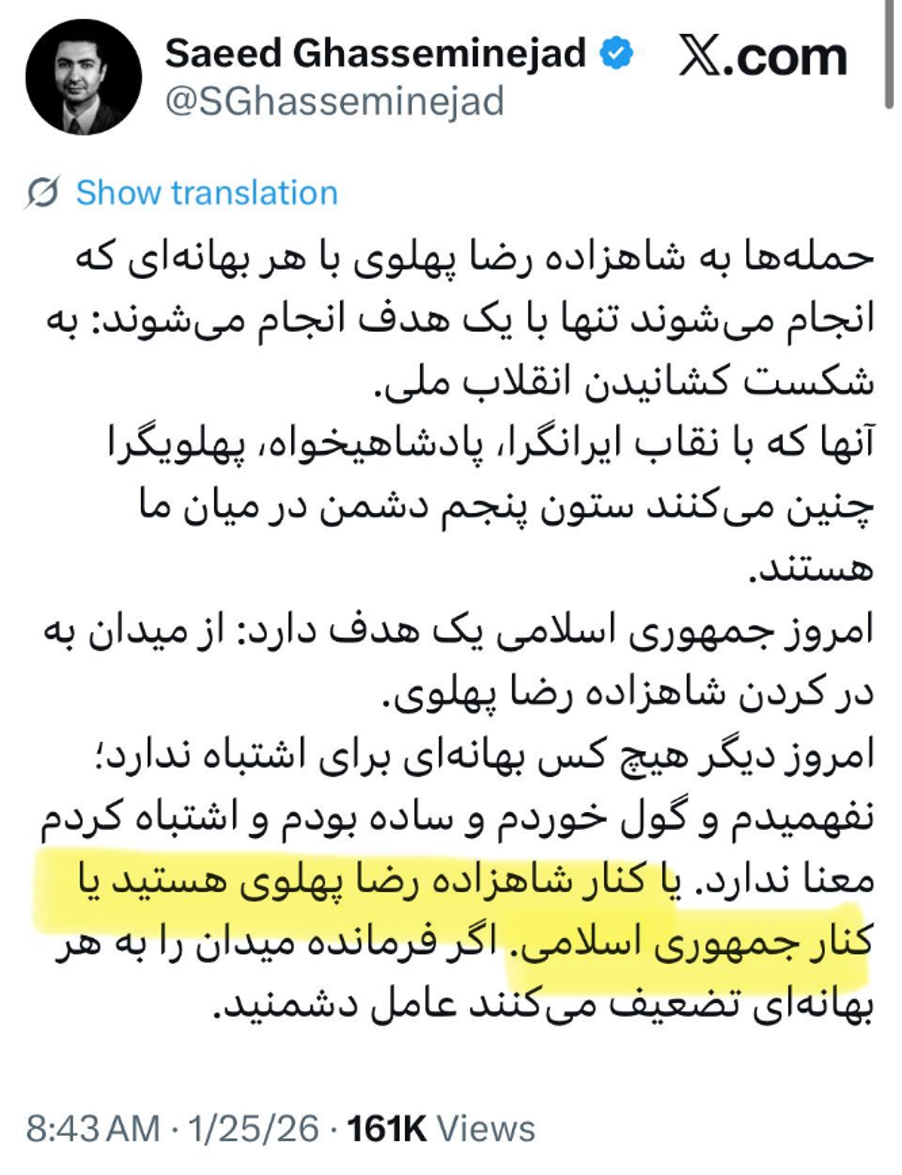
Key Finding 1: Exclusionary language and its amplification by people close to Reza Pahlavi.
Reuters also questioned Pahlavi about Yasmine Pahlavi’s repost of the three-enemy death slogan . His response described its origin in a Woman, Life, Freedom protest image, its removal, and her clarification that it targeted ideologies rather than people’s lives (approximately 14:41–15:20) . Amplification by a prominent associate is relevant to political normalization, but the clarification must accompany criticism of the repost .
Key Finding 2: Pahlavi lacked influence over his associates or failed to use the influence he had.
Key Finding 3: Senior advisory role makes this a matter of leadership accountability.
The Guardian reported that another Pahlavi adviser, Amir Etemadi, accused journalists and analysts of complicity in repression, warning: “You’re done for.” . His reported public warning uses intimidating language against perceived political adversaries, raising a direct concern about the protection of dissent within Pahlavi’s political network . Etemadi’s advisory role makes leadership’s response relevant to accountability . The statement supports scrutiny of whether such rhetoric is tolerated and does not, by itself, establish Pahlavi’s authorization or a coordinated strategy .
The accountability concern arises from the combination of an accusation of complicity with language that can reasonably be understood as threatening . Criticism of reporting, including allegations that it excuses state repression, is legitimate political expression . A warning directed at the people responsible raises a different question: whether it exposes them to intimidation for their work or views .
For this study, the relevant inquiry is whether such rhetoric contributes to an environment in which supporters treat perceived opponents as legitimate targets, and how leadership responds when these statements are brought to its attention . Taken separately, these messages support scrutiny of exclusionary language and its amplification by people close to Pahlavi . Silence after notice can contribute to an inference of tolerance when knowledge, practical influence, repeated opportunity to respond, and continued conduct are established . It cannot alone establish endorsement . “Inadequate response,” “tolerance,” “tacit endorsement,” and “direction” identify progressively different propositions; they should not be used interchangeably . The present evidence supports an unresolved enforcement question more securely than a finding of personal direction .
3.2 Transition Powers and Safeguards
This analysis concerns the February 2026 English edition of the Iran Prosperity Project’s Emergency Phase Booklet . Paragraphs 3–5 place leadership over transitional institutions, appointment or removal of the government and judicial heads after consultation, and military command in the transitional leader . The head of the Mehestan is elected by its members . Paragraphs 15.6–15.8 provide for a referendum, constituent assembly, and constitutional approval, including equal state-media access during the constitutional-form campaign . Paragraph 20 envisages an 18–24-month transition and conditions longer extensions on additional approvals, including a referendum for extensions exceeding twelve months . These provisions contradict a description of an entirely safeguard-free or indefinitely renewable emergency .
Key Finding 4: The proposed transition plan outlined in Iran Prosperity Project’s Emergency Phase combines concentrated, unelected leadership power with explicit electoral and procedural safeguards, but their ability to constrain that leadership remains insufficiently established.
The question is how effectively those safeguards constrain the office that initially holds substantial appointive and command powers . Consultation is not necessarily independent consent; a timetable is not its own enforcement mechanism . A democratic assessment should examine removal procedures, institutional independence, remedies for excluded competitors, and who can compel compliance if the leader or appointees breach the rules . If this model guides the movement, demands for personal allegiance in the diaspora would be structurally reinforced by a governing design that places personalized authority above democratic accountability . Evidence that identifiable actors invoke this leadership structure to delegitimize other opponents of the regime would strengthen the connection .
The relevance to intimidation lies in the protection of dissent: weak institutional checks could leave people branded as enemies vulnerable to exclusion or retaliation . Read together, the transition plan and documented incidents help assess whether present treatment of critics aligns with the proposed approach to governing .
3.3 Departures and Internal Criticism
Public criticism and departures have been reported among Pahlavi’s former associates and supporters, alongside criticism from media commentators . These individuals held different relationships to his leadership and should not be treated as a single organizational category :
- Hamed Sheibani Rad: Secretary-general of Iran-e Novin, reportedly left Pahlavi’s inner circle following his removal and subsequently criticized Pahlavi and his advisers .
- Mohammad Rahbar: An Iran International analyst, reportedly opposed the war during a live broadcast and resigned . His position at the broadcaster does not, by itself, establish membership in Pahlavi’s political network .
- Hamid Bayrampour: Described as an enthusiastic supporter, reportedly apologized publicly for his support and criticized Pahlavi’s positions, including the QR-code initiative aimed at recruiting Revolutionary Guard personnel .
- Behrouz Behboudi: A former sponsor, reportedly announced his break with Pahlavi and criticized his leadership and entourage . His claim to have contributed $20 million remains independently unverified .
Key Finding 5: The reported departures and criticism reveal disagreements within Pahlavi’s support base over leadership and political strategy. They challenge claims of political unity.
The evidentiary test is what a departure reveals: a documented complaint about decision rules, retaliation, finances, or dissent has greater analytical value than the departure alone . Unverified donation figures and examples showing only policy disagreement are excluded from the argument . A sequence of prominent exits may warrant investigation into organizational cohesion, but organizational collapse would require evidence about membership, resources, operational capacity, and continuity . The cases reviewed do not establish that outcome .
Exclusionary Rhetoric and Historical Accountability
4.1 Slogans and Experiences of Intimidation
Reported pro-Pahlavi mobilization includes eliminationist chants that collapse the distinction between opposing the ruling theocracy and excluding political competitors . Reporting and public material reviewed for this study describe death slogans against leftists and the Mojahedin at identified pro-Pahlavi events . Two formulations appear in the material supplied to this study :
- Three-enemy formulation: «مرگ بر سه فاسد: ملا، چپی، مجاهد» (“Death to the three corrupt: mullahs, leftists, and Mojahedin”)
- Four-enemy formulation: «مرگ بر چهار فاسد: ملا، چپی، تجزیهطلب، مجاهد» (“Death to the four corrupt: mullahs, leftists, separatists, and Mojahedin”)
The three-enemy wording is consistent with reporting of chanting at a Hamburg event, but its exact wording and frequency of circulation have not been independently authenticated . The four-enemy variant is retained as a research lead pending verified recordings or original posts .
By naming leftists, the PMOI/MEK, and, in a newer variant, people labeled “separatists” alongside the clerical regime as targets of “death,” these chants collapse distinct political constituencies into a single category of enemies . This framing can normalize intimidation by casting dissent as betrayal to be eliminated rather than as legitimate political disagreement . The study does not assume that every speaker intends literal violence . It examines how the language functions in context and how targeted participants understand and experience it .
To assess this rhetoric consistently, the study draws on the Council of Europe’s recommendation on combating hate speech, which calls for attention to an expression’s content, context, intent, and likely impact, with responses proportionate to its severity . The study uses this recommendation as an analytical lens, not as a legal verdict . It examines the chants’ content and context, how targeted participants experience them, and whether they occur alongside or are used to legitimize intimidation .
Interviews with Iranian Americans and Iranian Canadians who have participated in candlelight vigils and protests against Iran’s current regime describe distressing and psychologically intimidating encounters with people they identified as neo-Pahlavist supporters in several major North American cities . Several interviewees support the MEK or Kurdish parties . Some are former political prisoners; others are relatives of people killed by Iran’s current regime or by the former Pahlavi regime .
Some interviewees said these encounters recalled intimidation they had experienced or witnessed in Iran . One participant said: “This is what happens when Western media and policymakers give a platform to the wrong person. Pahlavi is doing the regime’s bidding.”
Across testimonies from participants at rallies opposing Pahlavi, interviewees repeatedly described profanity, obscene gestures, misogynistic insults, and sexually charged language by people they identified as neo-Pahlavist supporters . They characterized this conduct as routine at the events they attended, rather than as isolated incidents . Because interview documentation is incomplete, these accounts should be understood as testimony about the events experienced by these participants, not as a prevalence estimate .
Such behavior can turn political disagreement into personal humiliation and intimidation . For those targeted, speaking against Pahlavi may bring public degradation as well as political opposition . These accounts show how hostile encounters can make participation more difficult and may discourage people from attending or speaking at future rallies .
Key Finding 6: Participants across multiple generations, including some who have never lived in Iran, described neo-Pahlavist supporters’ misogynistic and sexually charged language as incompatible with the standards of dignity and respect they associate with Iranian social and political life.
One former political prisoner who survived torture in the 1980s drew a direct comparison to the language of prison intimidation: “The language is remarkably similar to what we heard from IRGC members in prison when they tried to intimidate and break us down.”
The three-enemy slogan calls for death to “mullahs, leftists, and Mojahedin,” grouping the ruling clerical establishment and distinct opposition constituencies within one hostile formula . Its circulation is supported by the Reuters discussion of the repost and rbb’s reporting of chanting at a Hamburg event . These sources establish examples, not frequency across rallies or support among monarchists generally . The four-enemy variant adding “separatists” remains a research lead pending an authenticated recording or original post .
“Eliminationist” is used narrowly here for language that represents named political categories as people or forces to be removed from legitimate political life through a death formula . It is not a finding that every speaker intends killing . Interpretation requires the complete words, audience, setting, surrounding conduct, and any explanation . The potential for intimidation is stronger where such language accompanies obstruction, identification of targets, or threats against individuals .
4.2 Kurdish Parties and the Separatist Designation
The Associated Press reported that a coalition of five Iranian Kurdish groups, including the Democratic Party of Iranian Kurdistan, Komala, the Kurdistan Freedom Party, PJAK, and Khabat, had formed to oppose the Islamic Republic and advance Kurdish rights . Reza Pahlavi responded with a strongly worded statement labeling these parties “separatists” and warning that a future Iranian army would carry out its patriotic duty to suppress them .
The supplied Persian screenshot of Pahlavi’s statement labels several groups separatist and presents territorial integrity as non-negotiable . It also argues that their claims provide the Islamic Republic with a pretext to portray itself as defender of national unity .
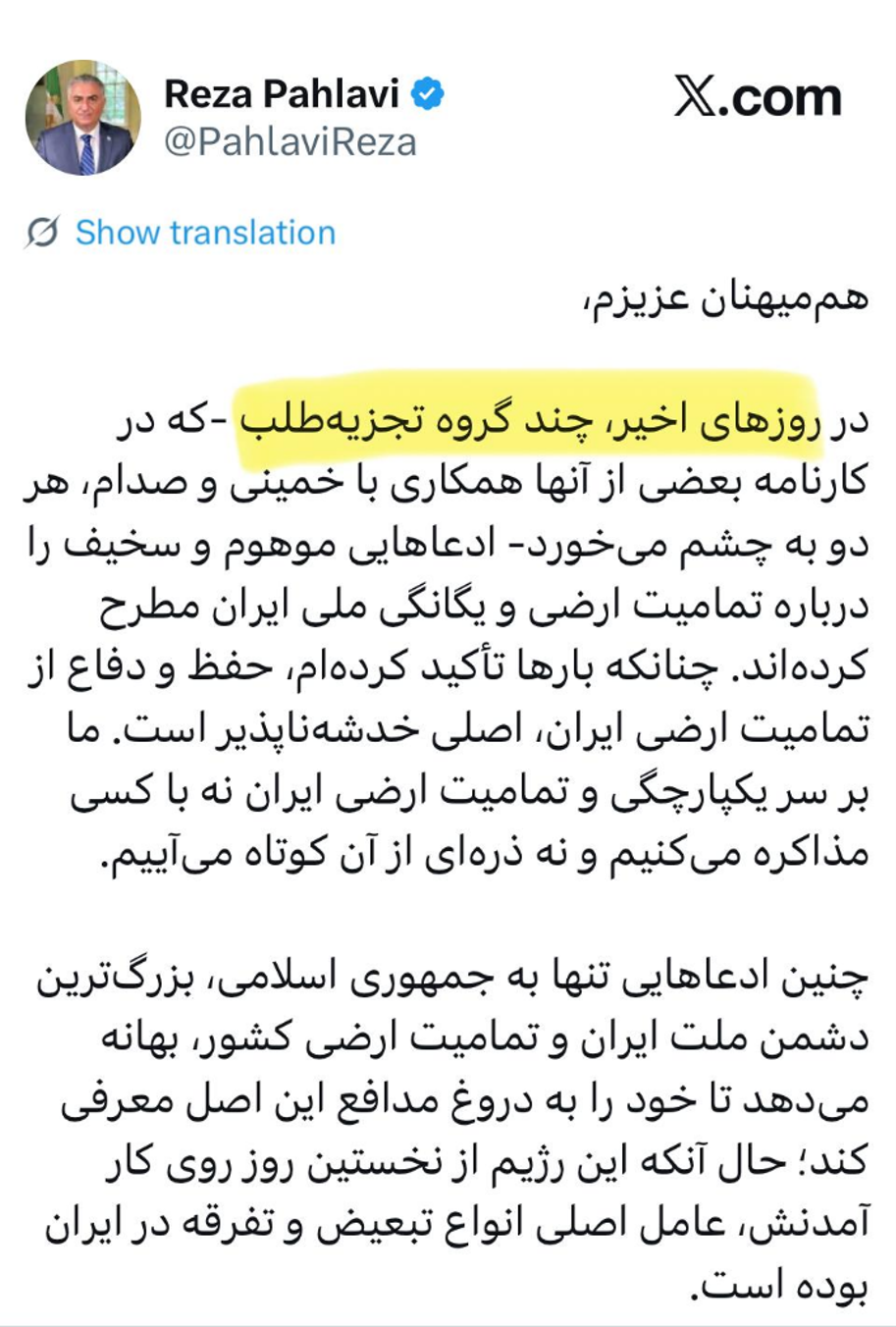
The statement drew immediate condemnation from Kurdish leaders and other democratic figures . They argued that threatening military force against Kurdish political movements revives the Pahlavi dynasty’s assimilationist legacy and echoes the security practices of Iran’s current regime . In their view, describing Kurdish parties as “separatists” turns demands for cultural equality, political representation, and decentralization into a security threat .
Key Finding 7: This framing has consequences beyond the dispute with the Kurdish parties. It can signal that ethnic groups seeking recognition of their rights may be treated as enemies of national unity and subjected to intimidation.
By narrowing the space for legitimate disagreement, such rhetoric risks deepening mistrust among Iran’s diverse political communities and obstructing the formation of an inclusive national coalition . Defending Iran’s territorial integrity is a legitimate political position and does not, by itself, constitute intimidation . The democratic test is whether that position allows peaceful disagreement over how the country should be governed . Advocacy for decentralization, regional autonomy, or ethnic rights should be assessed on its stated proposals and methods, rather than automatically equated with “separatists” . Equal citizenship requires that political participation remain open to all, regardless of ethnicity or membership in the diverse nationalities that together constitute the Iranian nation .
4.3 SAVAK Symbolism and Contemporary Responsibility
Over several months, the SAVAK emblem appeared repeatedly at pro-Pahlavi rallies, including alongside the crowned lion-and-sun flag . In Germany, marchers wore matching SAVAK shirts, and some messages directed at Pahlavi’s opponents added an intimidating edge . This section examines the documented displays and how people who reject Pahlavi’s leadership say they experienced them .
At the 10 May 2026 Regensburg demonstration, reporting describes matching white shirts bearing SAVAK imagery and a crowd estimated by police at about 170 . Radio Free Europe/Radio Liberty also documented displays of SAVAK symbols at royalist rallies abroad . These sources support recurrence in identified settings, not an increase measured against comparable earlier observations .
A supplied screenshot attributed to Sepehr Mohi and dated 10 May 2026 links a Regensburg gathering to SAVAK and claims that Pahlavi’s command was followed . Pahlavi’s public demonstration announcement did not mention SAVAK and does not establish his endorsement or direction of the displays .
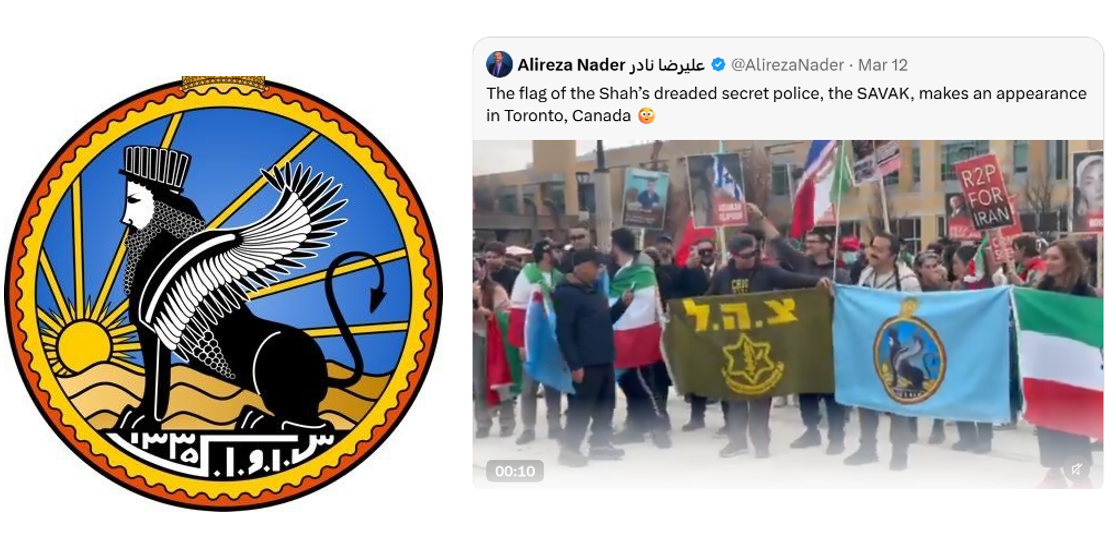
These displays invite a limited comparison with neo-Nazi mobilization: the revival of symbols associated with repression can glorify past abuses while signaling hostility toward present-day opponents . The comparison concerns methods of mobilization and intimidation; it does not establish shared ideology or organizational connections .
The democratic significance extends beyond whether a display violates German law . Calls to restore SAVAK and use it against broadly defined opponents raise a direct question about whether dissent would be protected in the political order these participants envision . In the rally footage described here, Sepehr Mohi identifies himself with SAVAK, addresses Reza Pahlavi directly, declares “We are here,” and asks him to give the command . This appeal expresses a participant’s claimed allegiance and willingness to act; it does not establish that Pahlavi issued instructions . Pahlavi’s demonstration announcement did not mention SAVAK, and the available evidence does not establish his endorsement or direction of the display .
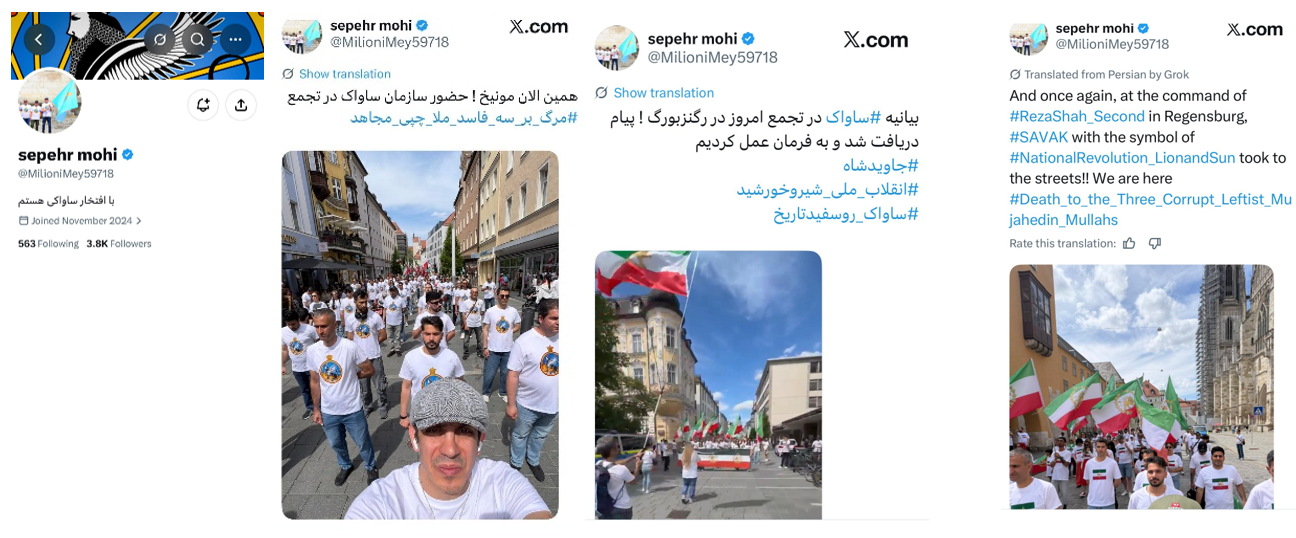
Similar imagery has been reported elsewhere . Radio Farda and RFE/RL reported SAVAK-associated symbols at pro-Pahlavi rallies in Manchester and Copenhagen . The Guardian documented SAVAK insignia on supporters’ clothing in London, while Jungle World reported SAVAK imagery in Regensburg and, separately, death slogans targeting political opponents at monarchist rallies . These reports should be assessed individually, including whether they draw on independent observations .
After controversy over gatherings featuring SAVAK insignia on shirts and flags, Pahlavi publicly disapproved of the displays on 28 May 2026 . The narrower question is how he explained that rejection and whether it established meaningful boundaries for supporters . He described the displays as providing ammunition to critics and situated them within what he characterized as a campaign against himself and his team . Some related posts remained accessible, and promotion continued after his statement . This indicates that his intervention did not establish an effective boundary among the supporters involved . Their continued conduct is consistent with resistance to his guidance, weak enforcement, or a perception that his objection carried no meaningful consequences .
On 24 October 2026, Hamed Fard, a self-described musical artist, released a music video on X titled “SAVAK” that glorifies the Shah’s former intelligence and security apparatus . In his accompanying public statement, Fard wrote that mainstream media and leftist, communist, and Islamist movements had sought to discredit SAVAK, which he called “the most honorable intelligence organization in world history” .
Key Finding 8: Pahlavi explicitly disapproved of SAVAK displays but framed his objection primarily in terms of reputational harm to his movement. His statement does not amount to a broader repudiation of SAVAK’s repression, nor does it identify concrete measures to enforce his stated opposition.
The music video depicts Fard portraying an Iranian returning to the country following the collapse of the Islamic Republic, ostensibly to serve in a revived SAVAK under a future Pahlavi-led political order . His accompanying statement goes beyond defending SAVAK’s historical record, explicitly advocating the legitimacy of a powerful intelligence apparatus in a post-Islamic Republic Iran: “In my view, efforts to discredit SAVAK are attempts to undermine the very necessity of having a strong intelligence organization in a future Iran. It is as though the intention is to leave the country without an effective intelligence apparatus so that these groups can do whatever they please.”
Key Finding 9: The persistent use of SAVAK as a political symbol risks legitimizing repression and undermining the accountability, civilian oversight, and protection of dissent essential to a democratic Iran.
The significance of this portrayal lies in its presentation of SAVAK not merely as an institution whose historical reputation should be rehabilitated, but as a model for a future Iranian security apparatus . By characterizing criticism of SAVAK as an effort to weaken national security, Fard’s statement conflates legitimate scrutiny of an intelligence agency’s record with opposition to the existence of effective intelligence institutions . This distinction is particularly relevant to debates over democratic accountability, civilian oversight, and safeguards against political repression in a future Iran .
These reports establish recurrence at documented events and warrant scrutiny of the actors promoting the symbols, their accompanying messages, and their effects on targeted communities .
The relevant mechanism is symbolic rehabilitation: presenting a former coercive institution as honorable can signal that force against political opponents remains legitimate . Whether a particular display actually intimidates an audience requires contextual or testimonial evidence . Comparisons with neo-Nazi symbolism can illuminate that mechanism, but cannot establish equivalence between political ideologies, historical crimes, organizational structures, or contemporary supporters . A historical emblem alone does not prove operational continuity; its emotional and political significance nevertheless warrants scrutiny .
Pahlavi bears no inherited personal guilt for actions committed by his father or former officials . Contemporary responsibility arises from how a leader uses that history, responds to present glorification of repression, and protects those contesting the legacy . One compact standard is sufficient: acknowledge documented abuses; reject their repetition; recognize victims without requiring agreement with their politics; and support independent investigation and remedies .
In SVT’s 12 April 2026 interview, a question about family history elicited a comparison between women’s circumstances under the monarchy and the Islamic Republic, together with pride in the family’s achievements, Reza Pahlavi said: “I am proud of my heritage and of what was achieved during that time.” His response emphasized the achievements of the monarchy without addressing the human rights abuses associated with SAVAK in that answer . The statement illustrates his affirmative identification with the family’s political history, but does not establish his position on the documented repression carried out under his father’s government . This context matters: the answer concerned the political meaning of his inheritance, not a comprehensive examination of SAVAK .
The Guardian reported his criticism of SAVAK displays and quoted Nik Kowsar recalling Pahlavi’s opposition to torture in 2012 .
In the July Reuters interview, however, he described his family name as a political advantage while defending his own record of activity . These statements show the continuing relevance of dynastic identity and also supply contrary evidence to an assertion that he has never opposed torture . The reviewed statements do not establish his entire historical position . The unresolved question is whether specific, consistent public boundaries and practical action accompany broader declarations .
The question of how political leaders confront authoritarian family legacies is particularly consequential when they invoke those legacies as a source of contemporary political authority . In such circumstances, historical accountability is not merely a matter of personal or familial identity . It becomes a test of democratic leadership, institutional responsibility, and the treatment of political dissent .
4.4 Parviz Sabeti and Civil Litigation
SAVAK symbolizes the repressive legacy of the Pahlavi monarchy because it embodied the state’s power to surveil, imprison, torture, and silence political opponents . For survivors and victims’ families, its emblem carries the memory of coercion exercised under Mohammad Reza Shah . Its revival at contemporary political rallies therefore raises questions about how participants understand that history and what role they envision for dissent in Iran’s future . When displays of the emblem accompany calls to restore SAVAK and target rival opposition groups, they suggest an effort to rehabilitate the institution as a legitimate instrument of political control .
Key Finding 10: For the Iranian diaspora, Parviz Sabeti has become a symbol of the former regime’s repressive legacy.
The significance of Sabeti’s case extends beyond disputed accounts of his relationship with Reza Pahlavi . Sabeti’s renewed public visibility in 2023, alongside efforts to rehabilitate SAVAK, places survivors’ pursuit of justice directly within the debate over Iran’s democratic future . Political leaders’ responses to that pursuit provide a concrete test of their commitment to accountability .
Regardless of any past or present relationship with Sabeti, Pahlavi has a clear opportunity to affirm survivors’ right to seek justice, support an independent judicial process, and reject the rehabilitation of institutions associated with political repression . Supporting these principles requires no prejudgment of Sabeti’s liability . Failure to articulate that position would constitute a missed opportunity to demonstrate that accountability applies equally to abuses committed under the monarchy and the Islamic Republic .
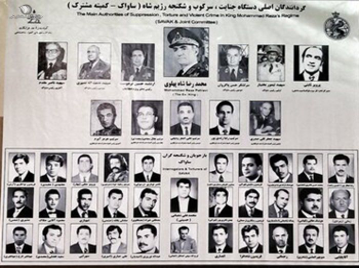
For many in the Iranian diaspora, Parviz Sabeti has become a symbol of the Pahlavi state’s repressive legacy . Political leaders’ responses to efforts to rehabilitate him can therefore serve as one measure of their commitment to justice and accountability .
Sabeti was a senior official in SAVAK . In Doe I v. Sabeti, three plaintiffs allege that he served as SAVAK’s deputy director, headed its Third Division, which was responsible for internal security, and chaired the Joint Anti-Sabotage Committee . They further allege that he exercised command over the security apparatus and ordered or approved torture . These are allegations presented by the plaintiffs and their counsel, the Center for Justice and Accountability (CJA), rather than judicial findings concerning Sabeti’s responsibility . Sabeti has denied involvement in torture and has said that he opposed it .
The plaintiffs brought civil claims under the U.S. Torture Victim Protection Act . On October 6, 2026, the court denied Sabeti’s motion to dismiss the claims as untimely, according to CJA, and the case is proceeding to discovery . That ruling addresses whether the case may continue; it does not determine whether the torture allegations are true .
The reported relationship between Sabeti and Reza Pahlavi also requires careful attribution . In 2025, The Guardian reported that Sabeti had worked as Pahlavi’s “security adviser,” citing a 2023 article published by the National Council of Resistance of Iran . The Guardian’s report establishes that the description was publicly made; it does not independently establish the appointment’s scope or duration .
Separately, former Pahlavi adviser Ahmad Ali Massoud Ansari stated in 2012 that Sabeti visited Pahlavi in Connecticut during the 1980s . Ansari also described a proposed financial arrangement involving Sabeti, a claim that has not been independently verified .
That year, journalist Nikahang Kowsar reported that Pahlavi’s office denied an ongoing relationship; Kowsar later withdrew his earlier claim that Sabeti had advised Pahlavi . Taken together, these accounts support reporting allegations of historical contact while leaving the nature and duration of any advisory relationship disputed .
The case’s relevance extends beyond the symbolic use of SAVAK insignia or competing interpretations of the monarchy’s history . It places allegations of individual responsibility before a court while survivors seek a legal remedy . Whatever the evidence may establish about Sabeti’s relationship with Pahlavi, political leaders can affirm survivors’ right to pursue claims through due process and support accountability based on evidence . Pahlavi’s lack of a public response to the case should be considered when assessing his commitment to justice and accountability .
Participation and Public Diplomacy
5.1 Incident Registry
Table 1 is a source-indexed registry of reported episodes . It separates the event description from the source and legal status . “Reporting” means that a journalist’s account was reviewed; a police report or judgment mentioned in that account is not represented as a document reviewed directly . “Testimony” records a participant’s account . Entries remain allegations except where a specific adjudication is identified, and even a reported conviction is not silently expanded to establish political direction .
| Record and Date | Reported Conduct | Source and Status |
|---|---|---|
| R01 Netherlands 16 January 2026 |
Hague-based engineer: alleged online targeting and employer pressure. | Reporting. Reuters describes a police report; the underlying document was not reviewed. Political attribution follows the reporting . |
| R02 Austria February 2026 |
Vienna restaurant owner Mehdi Shahparveri: threats and coercive conduct attributed to a Pahlavi supporter. | Reporting of adjudication. Reuters reports a conviction for dangerous threat and coercion. Judgment, defendant’s identity, case number, and exact disposition require direct confirmation . |
| R03 Online / United States Reported 16 April 2026 |
An anonymous account targeted diaspora figures; Alireza Nader described withdrawal from public online activity. | Reporting and attributed testimony. Anonymous political alignment does not establish an organizational role. Occurrence dates and archive captures remain incomplete . |
| R04 United Kingdom 9 March 2026 |
London: alleged assault on Kurdish reporter Dilovan Emadaldin Silashor. | Reporting. Reuters describes two arrests and release without charges as of its July report, and includes an alleged participant’s denial. Arrest does not establish guilt; later status requires checking . |
| R05 United States March 2026 |
Texas CPAC-related episode: alleged vehicle threat raised in the Reuters interview. | Reported allegation. Inclusion records that the allegation was raised. A primary police record, precise date, identities, and independent incident verification remain outstanding . |
| R06a Germany After 23 April 2026 |
Journalist Pauline Jäckels: threats following critical questioning in Berlin. | Reporting and attributed testimony. rbb describes threats and abusive messages. The Hamburg prosecutor confirmation in the same report concerns a different complainant . |
| R06b Germany Reported 28 May 2026 |
Activist Shadi Amin: reported rape threats and protective arrangements. | Reporting and attributed testimony. rbb describes a video supplied to the broadcaster; the original unavailable video was not independently authenticated here . |
| R07 United Kingdom Reported 27 May 2026 |
London, Church House Westminster: alleged obstruction and intimidation at an opposition gathering. | Reporting. Foreign Policy describes police-assisted departure. No underlying police document was reviewed directly . |
| R08 United States 22 September 2026 |
New York: NCRI reports that Reza Ebrahimi assaulted a demonstrator identified as Mani. FISN members report witnessing the confrontation. | Participant reporting and testimony. NCRI reports an arrest. Docket CR-018248-26NY, alleged charges, identities, and current status require direct court confirmation. No conviction is asserted . |
| A01 Australia Reported 23 February 2026 |
Borna Kazerani described threats and stopped attending rallies. | Reporting and testimony. ABC describes threats from different political sources; attribution of each message must remain specific. No judicial finding is asserted . |
| A02 Australia Reported 29 June 2026 |
Melbourne: “Sara,” a pseudonym, described being called a traitor for not joining a pro-Pahlavi chant. | Reporting and testimony. Other attendees intervened. Exact event date is not the publication date. Distress is reported; sustained withdrawal is not established . |
| A03 Australia Reported 17 September 2026 |
Kylie Moore-Gilbert described prior online death and rape threats associated with criticism of Pahlavi. | Reporting and testimony. ABC’s interview distinguishes aggressive participants from moderate supporters. The reporting date is not an incident date . |
The registry contains twelve records across six countries: R01–R05, R06a, R06b, R07–R08, and A01–A03 . They are not twelve independently adjudicated offenses . R06a and R06b separate two targets previously bundled in the same reporting . Some records concern sustained online harassment; others concern particular gatherings . The table is an inventory for scrutiny, not a denominator-based measure of risk . Uncertain occurrence dates, unresolved source access, and different levels of corroboration prevent a reliable escalation estimate .
The rbb report also describes an assault allegation involving Farbod Mahoutchiyan at a Hamburg photo exhibition and a prosecutor-confirmed investigation . That confirmation belongs to that episode, not to the separate threats against Pauline Jäckels or Shadi Amin . It remains contextual here until a separate registry record with date and case details is completed .
5.2 Canadian Homicide Tracked Separately
The Royal Canadian Mounted Police reported that Dr. Masood Masjoody’s remains were found on 6 March 2026 and that Mehdi Ahmadzadeh Razavi and Arezou Soltani were charged with first-degree murder following arrests on 13 March . Its release identifies an ongoing inquiry into circumstances and motive . Charges are not convictions . The police statement does not establish a political motive or direction by Pahlavi . C01 is therefore excluded from the registry count and from findings about political intimidation .
5.3 Documented Participation Costs
The most defensible participation findings concern identified people and their own reported decisions . ABC reports that Borna Kazerani stopped attending rallies after threats; AP describes Alireza Nader’s withdrawal from public online engagement . These are reported behavioral effects, not estimates of the share of critics who withdraw . ABC’s account of “Sara” describes distress at a specific encounter, not a measured long-term change in participation .
Accounts of threats to journalists and academics demonstrate a burden on people engaged in public debate . Protective arrangements described in German reporting indicate additional practical costs in particular cases . They do not quantify resources diverted from advocacy, reduced institutional cooperation, or altered policymaker decisions . Kylie Moore-Gilbert’s account also distinguishes an aggressive subset from moderate supporters; that distinction is important when interpreting the scope of the problem .
Research on fear of harassment and women’s online political participation offers a relevant mechanism for examining withdrawal . Southern’s study concerns British electoral participation online and cannot supply an effect size or causal finding for the Iranian diaspora . It supports asking how anticipated harassment affects expression, while the present case study must establish its own evidence .
5.4 Representation and Possible Political Effects
Disruption can make a gathering less accessible to competing voices . Threats can make an interview, social-media post, or public appearance personally costly . If these effects systematically silence some positions more than others, visible participation could become a misleading guide to political support . The registry establishes grounds to investigate this mechanism, not proof that journalists or policymakers have already adopted a distorted picture because of it .
The same distinction applies to cooperation and Tehran’s possible advantage . Fear may inhibit cross-factional work, and public conflict may provide material for hostile propaganda . Demonstrating those outcomes would require records of abandoned collaborations, expenditure on protection or litigation, changes in media sourcing, and evidence of how state-linked actors used the incidents . No claim of regime direction follows from the possibility that it benefits .
Future research should combine confidential interviews with systematic sampling of events and online activity, document nonparticipation as well as visible protest, and compare exposed and less-exposed groups . Longitudinal follow-up could distinguish immediate distress from sustained withdrawal . Studies of journalists’ sourcing and policymakers’ meetings could test representational effects directly . These questions remain open rather than being resolved through the accumulation of alarming examples alone .
Conclusions
Taken together, the ten findings put Pahlavi’s democratic leadership in serious doubt: he has not shown that he can or will curb intimidation, hold influential associates accountable, or protect political pluralism .
Across several countries, the report documents case-specific accounts of threats, harassment, gendered abuse, event disruption, and in-person confrontation . Some people report withdrawing from political activity or taking protective measures; some incidents entered police or court processes, with legal status varying by case . These accounts establish serious harms and concrete costs to participation . They also raise a broader democratic question: can Iranians in the diaspora criticize a prominent political leader, advocate a different constitutional future, and organize peacefully without fear of retaliation?
For a leader seeking a role in Iran’s future, the relevant test is whether he or she can protect peaceful dissent and hold identifiable associates accountable for intimidation .
Pahlavi’s name recognition gave him a political platform and an opportunity to address his family’s authoritarian legacy . That opportunity presented three possible approaches: defending the legacy, repudiating its abuses, or pursuing active accountability centered on victims and scrutiny . These are analytical categories, not mutually exclusive positions; a political figure’s record may contain elements of more than one . The three public statements examined here show Pahlavi affirming the political value of his family’s legacy while leaving questions about SAVAK’s historical abuses and contemporary rehabilitation unresolved . They do not establish a sustained commitment to comprehensive repudiation or victim-centered accountability .
This history matters because Pahlavi is a contemporary political actor seeking to shape Iran’s future . How he addresses his family’s legacy bears on how his movement understands state authority, political dissent, institutional accountability, and the rights of people who reject his leadership . For institutions engaging with him, the test is practical: look for transparent standards, consistent enforcement, protection for dissent, independent checks on transitional authority, and honest acknowledgment of past abuses and their victims . The central democratic question is whether Pahlavi will confront the abuses of the legacy he invokes with the same clarity with which he celebrates its achievements . Until those commitments are demonstrated in practice, his claim to democratic leadership remains a fallacy .
Appendix A: Historical Comparison and Its Limits
Historical comparisons here are purposive illustrations of mechanisms, not a representative sample of descendants of authoritarian figures . They are selected because accessible firsthand accounts or institutional records illuminate acknowledgment, victim engagement, or the distinction between historical and contemporary responsibility . Differences in regimes, crimes, political roles, and national settings limit what can be inferred about Iran .
| Case | Political Pathway | Response to Inherited Legacy |
|---|---|---|
| Reza Pahlavi Iran |
Seeks a leadership role in a prospective transition; no electoral mandate is examined in this report . | Affirms pride in family achievements and the political value of the Pahlavi name. His reported response to SAVAK displays emphasized their political consequences without an unequivocal judgment on the organization’s abuses . |
| Alessandra Mussolini Italy |
Elected to the Italian Chamber of Deputies in 1992 . | Called the 1938 racial laws a mistake while describing her overall assessment of Fascism positively . |
| Marine Le Pen France |
Led the National Front, founded by her father, Jean-Marie Le Pen . | During her leadership, the party expelled her father in 2015 after a public conflict over his statements. This documents a boundary around his party role, not a complete break with inherited ideology . |
| Niklas Frank Germany |
Journalist; included as a non-electoral familial response . | Publicly confronted his father’s Nazi crimes and supported compensation to victims and their descendants . |
| Horst von Wächter Austria |
Participant in historical-memory debates; not a comparable electoral political leader . | Described it as a son’s duty to find good in his father, illustrating familial defense of Otto von Wächter’s legacy . |
Note. The cases are not evidence of ideological equivalence among the Pahlavi monarchy, European fascist regimes, or contemporary descendants . The two non-electoral cases illustrate familial responses to historical wrongdoing; they are supplementary examples rather than direct comparisons of political leadership .
Political leaders who invoke family legacies can be assessed by how they acknowledge abuses and limit their rehabilitation . The non-electoral cases illuminate historical memory but are not like-for-like leadership comparisons . For Pahlavi, the question is whether he distinguishes national security from repression and rejects celebratory SAVAK symbolism .
Three responses to inherited authoritarian legacies can be distinguished analytically: rehabilitation that celebrates a coercive institution; selective acknowledgment that separates claimed achievements from abuses; and active accountability that recognizes victims and supports investigation . These are descriptions of conduct, not permanent categories of people . The same individual may change position or combine elements of more than one response .
Niklas Frank’s interview discusses his father’s role under Nazism and supports acknowledgment and compensation for victims . It illustrates a descendant’s active rejection of an inherited political legacy, not a universal obligation to adopt his language or politics .
Alexandra Senfft’s firsthand essay describes engagement with Holocaust survivor Tomas Reichental and the difficulties of confronting her grandfather Hanns Ludin’s role . It illustrates that victim engagement can involve disagreement, failed dialogue, and sustained work rather than a single public declaration . It does not make agreement with a victim’s political organization a condition of recognizing harm .
The comparison with SAVAK symbolism is limited to the political use of a repressive past . It does not equate the historical systems, their scale of violence, or current supporters’ beliefs . The main text’s accountability standard concerns observable contemporary choices rather than ancestry .
For the 1967 Berlin precedent, the German History in Documents and Images record identifies Karl-Heinz Kurras as the policeman who shot Benno Ohnesorg . The Stasi archive documents Kurras’s relationship with East German intelligence . Those distinct facts do not establish a Stasi or SAVAK order to kill . Assertions about pro-Shah violence during the visit must be sourced separately from responsibility for the fatal shot .
The 30 December 1976 US telegram similarly preserves uncertainty: it describes allegations about intelligence collection among Iranian students, conflicting accounts, and diplomatic denials . Its value is evidence of contemporaneous concern and official exchanges . It is not proof of continuity between those historical activities and a present diaspora network .
Appendix B: Documentary Illustrations
The documentary illustrations analyzed throughout this report are reproduced in full context within their respective narrative sections above . They represent qualitative exhibits subject to stated provenance and authentication limits, rather than independently authenticated primary originals :
- Figure 1 (Section 3.1): Saeed Ghasseminejad post screenshot (25 January 2026) framing loyalty to Reza Pahlavi .
- Figure 2 (Section 4.2): Reza Pahlavi statement excerpt (25 February 2026) regarding Kurdish political coalitions and territorial integrity .
- Figure 3 (Section 4.3): Video still showing SAVAK-associated flag design displayed at a gathering identified as Toronto, Canada .
- Figure 4 (Section 4.3): Street procession and post by Sepehr Mohi identifying as the “SAVAK People’s Group” in Regensburg, Germany .
- Figure 5 (Section 4.4): Archival poster depicting the principal authorities of the Shah regime’s apparatus of repression and torture (SAVAK and Joint Committee) .
Notes
- Court docket details for CR-018248-26NY (Criminal Court of the City of New York) remain subject to primary verification from official judicial records . Section 5 records the New York episode as an allegation supported by participant reporting and testimony rather than an adjudicated criminal finding . ↩
References
Aeria, G. (2026, June 29). False accusations and mistrust divide Iranian diaspora from within. ABC News.
Associated Press. (2026, February 27). Tensions between son of Iran’s last shah and Kurdish dissidents show cracks in Iranian opposition. [Original coalition declaration and exact faction names require verification].
Azizi, A. (2024, April 22). The fiasco of Iranian diaspora politics. New Lines Magazine.
Baker, E. (2026, February 23). Iranian diaspora says they face threats and intimidation in Australia. ABC News.
Center for Justice and Accountability. (n.d.). Doe I v. Sabeti: Case summary and perpetrator profile. Retrieved October 25, 2026. [The organization represents the plaintiffs; its allegations are not adjudicated facts].
Coleman, J. (2026, September 17). Iranian-Australian academic reflects on online abuse and diaspora intimidation. ABC News.
Council of Europe. (2022). Recommendation CM/Rec(2022)16 of the Committee of Ministers to member States on combating hate speech.
Doe I v. Sabeti, No. 6:25-cv-00219-GAP-DCI, Doc. 137 (M.D. Fla. Dec. 22, 2025). Court order concerning protective measures and anonymity.
Doleśniak, O. (2026, May 21). Honourable mention: Interview with Niklas Frank. European Network Remembrance and Solidarity. (Originally published by Berlinski Tygiel on May 31, 2025).
Duwe, S., Sagmeister, J., & Wölfle, M. C. (2026, May 28). Zwischen Schah-Kult und Bedrohungen: Wie gespalten ist die iranische Opposition? rbb Kontraste. [German-language reporting; English summaries are editorial translations].
European People’s Party Group. (n.d.). Alessandra Mussolini: Parliamentary record. European Parliament.
Fard, H. (2026, October 24). SAVAK [Music video and accompanying statement]. X. [Post attributed to @itshamedfard; complete content, context, and translation require verification].
Free Iran Scholars Network. (2026). Documentary images and witness material supplied with the FISN research manuscript [Unpublished research materials].
Geller, A. (2026, April 16). Killing of Iranian activist in Canada exposes increasingly bitter divisions within the diaspora. Associated Press.
German History in Documents and Images. (1967, June 2). The death of Benno Ohnesorg. German Historical Institute.
Iran Prosperity Project. (2026, February). Emergency Phase Booklet (English ed.). Political chapter, 176-page PDF; paragraph numbers cited in text.
Jewish Telegraphic Agency. (1992, April 8). Mussolini’s granddaughter wins seat in Italian Parliament.
Kazerounian, K. (2026, January 28). Reza Pahlavi’s blueprint for dictatorship. Free Iran Scholars Network.
Khoshnami, P. (2026, March 21). Inside the court of Iran’s opposition leader. New Statesman.
Kolbarnews. (2026, February 25). Statement in response to Reza Pahlavi’s remarks on “territorial integrity.” [English-language statement].
Kowsar, N. (2012, March 8). تصحیح بعد از ۶ سال! پرویز ثابتی هیچ ارتباطی با رضا پهلوی ندارد [A correction after six years! Parviz Sabeti has no connection with Reza Pahlavi]. یادداشتهای نیکآهنگ کوثر [Nikahang Kowsar’s notes]. https://nikahang.blogspot.com/2012/03/blog-post_132.html
Luscombe, R. (2025, September 11). After years living quietly in Florida, Shah of Iran’s alleged “chief torturer” faces lawsuit. The Guardian.
Luscombe, R. (2026, October 8). Florida judge allows lawsuit against Shah of Iran’s alleged “chief torturer” to move forward. The Guardian.
National Council of Resistance of Iran. (2026, September 23). Pro-Shah supporters attack PMOI at New York rally against Iran’s clerical regime. [Participant organization’s statement].
Naumann, F. (2026, May 13). Für Folter bekannt: Iran-Demo in Bayern feiert berüchtigte Geheimpolizei – Appell an Söder folgt. Frankfurter Rundschau. [German-language reporting; English summaries are editorial translations].
Nordstrand, M. (2026, April 12). Reza Pahlavi: Många som var emot min far stödjer mig. SVT Nyheter. [Swedish-language interview report; English summary is an editorial translation].
Office of the United Nations High Commissioner for Human Rights & University of California, Berkeley Human Rights Center. (2022). Berkeley Protocol on Digital Open Source Investigations. United Nations.
Pahlavi, R. (2026, February 25). Persian-language statement on territorial integrity [Post]. X. Account: @PahlaviReza.
Pineau, E. (2015, August 20). France’s National Front expels founder Jean-Marie Le Pen. Reuters.
Radio Farda & Tizard, W. (2026, May 14). Symbols of the Shah’s secret police seen at Iranian royalists’ rallies abroad. Radio Free Europe/Radio Liberty [Video].
Rahmani, B. (2012, August 3). تحرک تازه سلطنت طلبان و ساواکی و تبرئه ساواک و ساواما توسط ثابتی و قانعی فرد! [Renewed activity by monarchists and SAVAK affiliates and the exoneration of SAVAK and SAVAMA by Sabeti and Ghanei Fard!]. Rangin Kaman. https://rangin-kaman.net/2012-08-03-00-07-20/
Reuters Connect. (2026, July 14). Reza Pahlavi speaks to Reuters about Iran’s future [Video and transcript]. Paris.
Reuters. (2026, July 28). Reza Pahlavi speaks to Reuters about Iran’s future. Published interview.
Rimawi, M. (2026, May 27). Inside the struggle to build an Iranian opposition. Foreign Policy.
Royal Canadian Mounted Police, Integrated Homicide Investigation Team. (2026, March 15; updated March 17). Two charged in relation to the murder of Masood Masjoody (IHIT file 2026-151).
Sands, P. (2020). The Ratline: Love, lies and justice on the trail of a Nazi fugitive. Weidenfeld & Nicolson.
Senfft, A. (n.d.). Living with the dead: Sharing the truth and the pain of the past [Essay]. Author-hosted essay, pp. 1–3.
Southern, R. (2026). Does fear of harassment reduce women’s online political participation? Evidence from the British Election Study across three UK general elections. European Journal of Politics and Gender, 9(1), 223–243. https://doi.org/10.1332/25151088Y2024D000000027
Stasi Records Archive. (n.d.). Der Geheime Mitarbeiter “Otto Bohl.” German Federal Archives.
Stecklow, S., Layne, N., & Finch, G. (2026, July 28). Regime change? Inside Reza Pahlavi’s faltering bid to lead Iran. Reuters Investigations.
Tait, R. (2026, June 3; updated June 5). Far-right praise for shah’s secret police puts Reza Pahlavi on the spot. The Guardian.
U.S. Department of State, Office of the Historian. (1976, December 30). Document 199: Telegram from the Department of State to the Embassy in Iran, “SAVAK activities.” Foreign Relations of the United States, 1969–1976, 27.
Wintour, P. (2026, January 17). The Iranian state silenced protests with brutality. What now for Iran’s opposition? The Guardian.