Dr. Ali Bagheri. Senior Research Engineer, Belgium
Overview and Context
Iran faces a severe water and electricity crisis. Power outages are no longer occasional disruptions. They have become a persistent reality for millions of people. The impacts are economic, social, and psychological.
Officials often blame sanctions, external pressures, or climate change. Those factors matter. They are not the main cause. Decades of corruption and mismanagement created this crisis.
Investment in essential infrastructure has stagnated. Budgets favor politically connected projects. Grid maintenance lags behind demand growth. Rural and low income communities carry the heaviest burden.
Independent researchers and parliamentary assessments warn about structural risks. Peak demand increases faster than new capacity. Grid losses remain high. Transparency is limited, which hinders real reform.
Economic Paralysis and Industrial Collapse
The economic cost of electricity shortages is staggering. Iran’s industrial sector has been brought to its knees by recurring power cuts. Factories that need steady power halt production for hours. Supply chains break, and delivery deadlines slip.
Economic reports estimate heavy losses to firms in industrial towns between 2021 and 2024 [1]. Energy intensive producers cannot plan their schedules. Capital flees uncertain environments. Unemployment rises as shutdowns become routine.
These problems are not accidental. They reflect years of poor planning and politicized subsidies. Cheap electricity prices have discouraged investment in new capacity. Maintenance budgets fall short of real needs [2].
Contracts often go to entities linked to the Islamic Revolutionary Guard Corps. Merit based procurement is weak. The result is a network with outdated equipment and frequent failures [3]. Many plants operate below capacity due to missing parts and deferred repairs.
Impact on Daily Life and Public Health
The crisis extends well beyond industrial zones. Families live with constant uncertainty about the next blackout. In summer, temperatures exceed 40°C in many provinces. Without electricity, cooling fails and heat risks rise.
Food spoils when refrigerators stop. Water pumps fail, and apartment buildings lose running water. Elevators trap riders and endanger the elderly. Hospitals in small cities struggle to keep critical machines on [3].
These conditions are not the result of a natural disaster. They reveal a political system that does not prioritize basic services. Instead of modernizing generation and transmission, resources go to ideological and security projects. Emergency admissions linked to outages increase in hot months.
Businesses buy costly generators to cope with blackouts. That cost passes to consumers. The result is higher prices and a lower standard of living. Trust in institutions declines as daily life becomes harder.
Climate and Water Mismanagement
Electricity shortages are inseparable from water mismanagement. A rush to build dams without sound planning has depleted rivers. Reservoir levels fall, which limits hydroelectric output. Drought amplifies these weaknesses [4].
A network often called the “water mafia” pushes diversion schemes and oversized projects. Rivers are redirected for political and commercial gain. Ecosystems and communities bear the cost. Hydropower becomes unreliable in dry seasons [5].
Parliamentary and media reports show sharp rainfall declines. Reservoirs near major cities reach record lows. Grid operators project much lower summer hydro output than in past years [4]. Heat waves increase demand at the same time.
Iran has not invested enough in efficiency and reuse. Other arid countries have expanded modern irrigation, recycling, and leak control. Iran’s slow adoption of these measures is a governance failure, not a technical limit. The longer reforms wait, the higher the future cost.
Psychological Toll
The dual crisis is also a mental health crisis. Blackouts and water cuts cause anxiety, frustration, and hopelessness. They are constant reminders of state neglect. People feel abandoned, especially far from Tehran.
Stress weakens social cohesion. It erodes trust in local and national institutions. In marginalized provinces, the sense of betrayal is deep. Power and water shortages often spark protests [6].
Education suffers when outages interrupt online learning and evening study. Students fall behind in exams and applications. Families spend more on candles, batteries, and bottled water. Inequality widens as wealthier households cope more easily.
Entrepreneurs avoid energy dependent ventures. Small firms close early to avoid peak outages. The cycle of fear and delay reduces community confidence. Recovery becomes harder with each season.
A Manufactured Crisis
Officials sometimes admit that decades of mismanagement are to blame. Iran has failed to expand generation in line with population and demand. Thermal plants are old and inefficient. Renewable energy still provides a very small share of production [7].
Promises of reform appear often, but results lag. Even in 2025, authorities resorted to emergency holidays to curb consumption. That step shows the depth of the shortage. It does not solve structural deficits [8].
Parliamentary researchers track widening gaps between peak demand and dependable capacity. Reports call for transparent data and steady investment. They also warn about fuel supply constraints that spill into electricity outages [9].
Corruption and opaque decision making block progress. Projects stall or finish with poor quality. Delays and cost overruns drain public resources. Without audit and accountability, the same failures repeat [3].
Resistance and Unrest
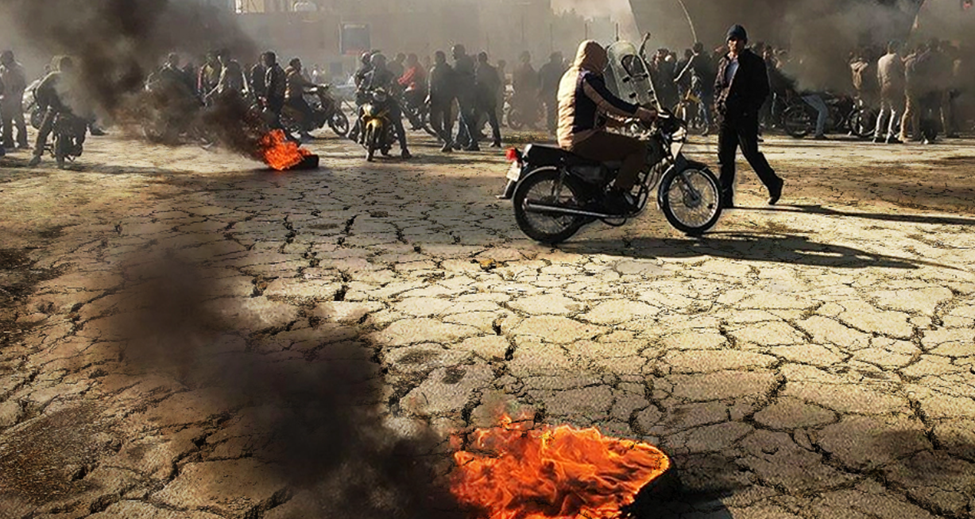
Water and electricity shortages fuel protests across the country. In Rasht on August 6, 2025, residents gathered at Sabzeh Meydan to denounce blackouts and water cuts. Chants demanded water, electricity, and life as basic rights. Confrontations followed with security forces [10].
These scenes echo earlier mobilizations by farmers in Isfahan. Demonstrators gathered on the dry bed of the Zayandeh Rud to demand fair water allocation. Police used force to disperse sit ins and marches. The grievances persist because the policies have not changed [11].
Protests often begin with practical demands. They quickly broaden into criticism of corruption and secrecy. Shortages disrupt livelihoods and widen regional gaps. Each episode leaves lasting scars.
Civil groups connect infrastructure failures to governance problems. Environmental activists document diversion schemes and illegal wells. Workers’ organizations warn about factory closures. The calls for transparency grow louder after each outage season.
Conclusion: The Crisis Is the Regime
Nature and sanctions play a role. They do not explain the depth of Iran’s shortages. The core problem is political. Loyalty outweighs competence, and secrecy replaces planning.
A durable solution requires more than quick fixes. The country needs accountable institutions and stable rules. Investors need credible data and independent oversight. Citizens need basic services they can trust.
A free and responsible government can rebuild confidence. It can attract capital and deploy clean technologies at scale. It can prioritize maintenance and protect the most vulnerable. It can also cooperate regionally on shared waters.
Until then, blackouts and water cuts will continue. The economic and moral costs will rise. People will leave hard hit regions, and industries will shrink. The price of delay will keep climbing.
References
[1] صنایع از قطعی برق چقدر خسارت دیدند؟ + جزئیات – خبرگزاری مهر. https://www.mehrnews.com/news/6381356
[2] Carnegie Endowment, “Iran’s Energy Dilemma: Constraints, Repercussions, and Policy Options,” June 2025. https://carnegieendowment.org/sada/2025/06/irans-energy-dilemma-constraints-repercussions-and-policy-options?lang=en
[3] The Washington Institute, “Mismanagement Makes Iran Vulnerable to a Different Type of U.S. Pressure,” 2024. https://www.washingtoninstitute.org/policy-analysis/mismanagement-makes-iran-vulnerable-different-type-us-pressure
[4] IRNA, “Hydropower output planned at 1,550 GWh in summer, 38% less than last year,” 2025. https://www.irna.ir/news/85889797
[5] Free Iran Scholars Network, Khani, Khalil, “Contribution of the Iran’s ‘Water Mafia’ in Water Bankruptcy,” 2025. https://freeiransn.com/contribution-of-the-irans-water-mafia-in-water-bankruptcy-an-fisn-project/
[6] Human Rights Watch, “Iran: Deadly Response to Water Protests,” July 22, 2021. https://www.hrw.org/news/2021/07/22/iran-deadly-response-water-protests
[7] Wikipedia, “Energy in Iran.” https://en.wikipedia.org/wiki/Energy_in_Iran
[8] Financial Times, “Tehran declares public holiday to tackle water shortage,” July 23, 2025. https://www.ft.com/content/16131834-cb47-481b-b7da-183398493ef6
[9] Majlis Research Center, “Monitoring Macro Electricity Indicators (1): 1402.” https://rc.majlis.ir/fa/report/show/1812492
[10] NCRI, “Iran News in Brief – August 8, 2025,” note on Rasht protest at Sabzeh Meydan. https://www.ncr-iran.org/en/news/iran-news-in-brief-news/iran-news-in-brief-august-8-2025/
[11] Al Jazeera, “Thousands protest in Iran’s Isfahan to demand revival of river,” Nov. 19, 2021. https://www.aljazeera.com/news/2021/11/19/thousands-protest-in-irans-isfahan-to-demand-revival-of-river