Inspired by Muskism: A Historical and Psychological Analysis of the Narcissism of Power, Savior-Centered Leadership, Modernization Without Freedom, and the Survival of Despotism in the Age of Artificial Intelligence
Iraj Abedini
Psychologist and Researcher in Political Psychology
October 2026
Introduction: Reactionary Power Armed with the Technology of the Future
Twenty-first-century authoritarianism can no longer be explained solely by reference to old ideologies, traditional forms of government, or conventional instruments of repression. One distinctive feature of our era is the possibility of an alliance between political reaction and the most advanced achievements of technology and global capitalism.
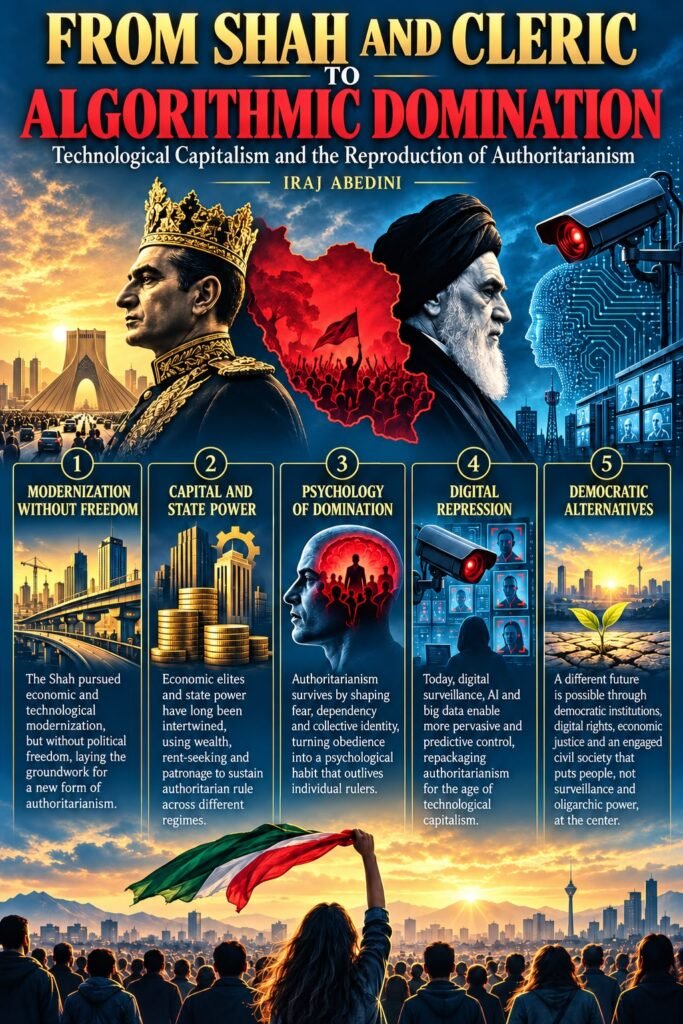
A government hostile to freedom, equality, and popular sovereignty may depend for its survival on technologies developed in some of the world’s most sophisticated scientific and industrial centers. In this arrangement, reactionary power does not necessarily reject technology. It reconstructs its authority by appropriating technological capabilities and selectively embracing technical modernity.
At the same time, the immense concentration of capital, communications infrastructure, and computational capacity in the hands of a relatively small number of corporations and technology owners raises a new question about democracy’s future: when technological power escapes public scrutiny and democratic accountability, can it become an economic partner in—and an enabler of—the survival of authoritarian governments?
Inspired by Muskism by Quinn Slobodian and Ben Tarnoff, this article examines that question through political economy and the psychology of power. Its subject is neither the personality of a single technology billionaire nor the conduct of one religious government. Rather, it investigates relationships in which the narcissism of power, savior narratives, concentrated ownership, and surveillance technologies may weaken democratic institutions and citizens’ autonomy. Here, these psychological concepts are interpretive frameworks and hypotheses, not clinical diagnoses of particular individuals.
Iran gives this problem a distinctive historical and political dimension. Despite the reactionary character of its governing ideology, the ruling clerical regime has used—and can continue to use—modern technologies to police women’s lives, identify opponents, monitor communications, and expand its repressive capacity. Yet Iran’s authoritarian history cannot be reduced to clerical rule. Monarchical power and the clerical establishment have sometimes cooperated and sometimes competed; in their unaccountable forms, both have been capable of restricting the people’s right to determine their political future.
The reproduction of authoritarian political culture within parts of the opposition also deserves attention. In the author’s view, leader-centered and coercive groups that intimidate, defame, or seek to eliminate independent voices in the name of opposing the clerical regime may function as proxies in effect for authoritarianism—not necessarily because of organizational ties, but because their conduct can erode social trust, exhaust democratic forces, and perpetuate authoritarian political relations. This description is an assessment of political effects; it does not, by itself, allege that these actors receive orders or money from the regime.
The central question, then, is whether the convergence of capital, technology, security institutions, and a political psychology of obedience can create a form of domination whose capacity for surveillance and intervention in everyday life exceeds anything earlier dictatorships could command.
Answering it requires us to examine together the economic organization of technology, the interests of authoritarian governments, the psychology of those who wield power, and the mechanisms that constrain individual autonomy and democratic participation.
1. Shah and Cleric: The Persistent Problem of Unaccountable Rule
Iran’s political history is more than a succession of dynasties or a changing wardrobe of rulers. A more persistent problem has been the concentration of authority in institutions over which ordinary people have had limited opportunities for effective oversight and participation. This is what makes the relationship between monarchy and the clerical establishment so important.
Under the Safavids, the association of political legitimacy with officially established Twelver Shiism, together with the growth of religious institutions, contributed to an order in which monarchical and religious authority became intertwined in different ways.[2] During the Qajar period, the clergy gained greater social and economic autonomy, and its relationship with the monarchy encompassed both cooperation and opposition. The Constitutional Revolution revealed that the clerical establishment was not a single political bloc: some religious figures supported constraints on royal authority, while others opposed aspects of constitutional law and emerging notions of equal citizenship.[3]
Thus, the expression “shah and cleric” does not imply an eternal, conflict-free alliance. It identifies two historically influential loci of authority that have shaped Iran’s political order, sometimes through coalition and sometimes through rivalry. The target of criticism is not personal religious belief or constitutional monarchy as such, but political power shielded from accountability.
Under the Pahlavi dynasty, the expansion of infrastructure, education, the military, and state bureaucracy coincided with the continued concentration of royal power, restrictions on political activity, and the repression of dissent. Technical and administrative modernization was taking place, but it did not guarantee an equivalent expansion of political freedom or independent oversight. After the monarchy fell in 1979, the clerical regime constructed a new system of concentrated power and restrictions on political and social rights, drawing its legitimacy from religious authority and the doctrine of velayat-e faqih, or guardianship of the Islamic jurist.
In this transition, the claimed source of legitimacy shifted from crown to turban, but the fundamental question remained unresolved: who has the authority to limit power and hold its holders accountable? The struggle between freedom and despotism cannot therefore be reduced to a simple choice between monarchy and religious government. The decisive standards are the people’s rights to choose, dissent, organize, and change their rulers peacefully.
2. Technological Modernization Without Political Modernity
Much of modern political thought has associated expanded education, communication, and scientific capacity with greater opportunities for citizen participation. Yet no automatic or necessary relationship connects technical progress to democratization. A government can build universities, expand communications networks, and introduce data-driven systems while restricting academic independence, press freedom, and civil rights.
This condition may be described as technological modernization without political modernity. Authoritarian rulers adopt those aspects of modernity that strengthen their administrative and coercive capacity while rejecting the principles that would subject their power to citizens’ rights.
An intelligent camera can assist with traffic management or emergency response, but the same infrastructure may be deployed to enforce restrictions on women’s clothing or identify participants in demonstrations. Better telecommunications can facilitate education and commerce, yet in the absence of legal safeguards they can also enable interception, network shutdowns, and the mapping of political opponents. Technology is not inherently democratic or repressive. Ownership, regulation, end users, and the possibility of public oversight shape its political consequences.
Digital authoritarianism differs from earlier forms not merely in speed. Previously scattered data can be combined, social relationships reconstructed from digital traces, and classification systems applied across large populations rather than isolated cases. Still, technical capacity should not be confused with total control: systems make errors, and human society remains unpredictable and capable of resistance.
3. Muskism: When the Promise of Autonomy Produces Infrastructure Dependence
In Muskism: A Guide for the Perplexed, Quinn Slobodian and Ben Tarnoff move beyond Elon Musk’s personality to examine a particular configuration of capital, technology, and political power.[1] In an April 2026 interview with Boston University, Slobodian compares the analytical concept of Muskism with Fordism: the issue is not simply what one individual says or does, but the social order implied by patterns of production, ownership, and ideas of governance.[4]
Within this configuration, technology is marketed as a route to autonomy, even as access to essential features of modern life becomes dependent on privately owned networks and their proprietors’ decisions. The power arising from control over communications infrastructure, computing services, and data is not merely economic. It may shape citizens’ ability to participate in public life, the circulation of information, and even government choices.
None of this makes a private corporation equivalent to a state possessing prisons and a monopoly on coercive force. Their institutional positions and responsibilities are fundamentally different. The concern is that two forms of concentrated power may converge: authoritarian states need infrastructure and technical tools, while technology companies may seek markets and profits. Such convergence can have political consequences without a shared ideology.
The democratic questions are therefore unavoidable. Who sets the terms of access? Who profits from dependence? How can citizens challenge decisions made by a corporation or a government? When technical competence and commercial success are treated as conferring a right to rule, “efficiency” risks being substituted for democratic consent and participation.
4. The Political Economy of Authoritarian Survival: Where Corporate Profit Meets Security Interests
Dara Conduit’s study in Government and Opposition on the global technology industry and digital authoritarianism in Iran provides important empirical support for this line of inquiry.[5] Conduit shows how foreign corporations may strengthen authoritarian resilience through commercial relationships even when they have no ideological sympathy for the regime.
She identifies four mechanisms. First, improved service delivery may bolster the government’s image of competence. Second, expanded technical capacity can also become available for surveillance. Third, economic benefits can be distributed among networks close to those in power. Fourth, technologies designed for monitoring and repression may directly enhance the coercive apparatus.
Her case studies involve MTN, Nokia Siemens Networks, and Tiandy. Communications interception technology and video-surveillance equipment illustrate how the boundary between legitimate applications and repressive uses becomes especially consequential under authoritarian rule. Corporate profits and a government’s security needs can overlap without agreement on political principles.
An ethical and analytical distinction is essential here: neither every telecommunications contract nor every sale of dual-use technology amounts to knowing participation in repression. The product’s design, foreseeable risks of misuse, the seller’s knowledge, the ultimate customer, and documented applications must be evaluated separately. A rigorous critique of political economy needs demonstrable mechanisms, not sweeping accusations.
5. Iran’s Clerical Regime and Surveillance Technology: Repression Modernized
Despite its ideological character and restrictions on personal freedoms, Iran’s ruling clerical establishment has long employed new technical means to maintain power. Communications monitoring, restrictions on access to information, surveillance of online activity, and systems used to enforce compulsory veiling demonstrate how advanced technologies can serve reactionary rules.[6]
Anthropic’s September 2026 report offers a recent example of AI use in activities connected to Iranian security institutions. According to the company, it identified and banned 16 accounts associated with two units linked to paramilitary and domestic-security agencies. Its report describes the analysis of 155,216 social-media posts, the development of an identity-harvesting tool, and work on a surveillance case-management system called “Arman.”[7]
These are Anthropic’s reported findings. The operational reach of every tool, as well as some figures claimed by the identified operators, would require independent verification. Nevertheless, the case illustrates how AI models can be used not only to generate content but also to develop software, analyze data, and reduce the technical costs of surveillance.
The central issue is the treatment of citizens as objects of data collection and classification. Instead of responding only to visible political acts, a government may combine communications networks, patterns of participation, and identifying information to produce security assessments. When this occurs without consent, independent judicial scrutiny, or an effective right of appeal, it creates new opportunities for arbitrary power.
The use of digital tools to enforce compulsory veiling offers a particularly stark example of the broader historical contradiction: modern technology can be mobilized to deprive people of personal choice. The machinery of repression is modernized while the principles of equality and individual autonomy remain denied.
6. The Psychology of Power: Narcissism, Savior Narratives, and the Temptation to Control
Political economy helps explain why governments and technology firms may become useful to each other. Political psychology asks which tendencies and relationships can reinforce concentrated power and an unwillingness to accept criticism.
In this article, the narcissism of power is not a clinical label attached to named individuals. It refers to patterns such as grandiosity, entitlement, perceived immunity from criticism, and claims that a leader is historically indispensable. Research in social psychology suggests that experiencing power can reduce certain behavioral inhibitions and, in some contexts, make people less attentive to others’ perspectives. These findings are conditional, however, and cannot be generalized to everyone in authority.[8][9]
In autocratic monarchy, the ruler may portray himself as the embodiment of the nation and its sole guarantor of order. In religious authoritarianism, claims to sacred mission or an exclusive interpretation of truth may become foundations of political legitimacy. In some forms of technological capitalism, commercial success and engineering competence may be invoked as evidence of superior qualifications to govern society. These sources of legitimacy differ, but they can converge in their preference for top-down decisions and their tendency to devalue independent oversight.
Savior-centered leadership becomes dangerous when criticism of the powerful is portrayed as an obstacle to society’s salvation. Personal loyalty may then displace general principles, and political disagreement can become an identity-based conflict. Research on identity fusion with a political leader suggests that, in some settings, intense identification can be associated with support for authoritarian conduct.[10]
At the group level, ordinary attachment to a collective identity must also be distinguished from collective narcissism. The latter involves a belief in a group’s exceptional greatness combined with a sense that its status has not been adequately recognized. It may increase sensitivity to criticism and hostility toward outsiders.[17]
Algorithmic systems can magnify the temptation to control. Vast quantities of data may encourage the illusion that society can be observed and adjusted like an engineered machine. But people are more than bundles of behavioral indicators. Statistical knowledge cannot replace their right to choose, and predictive accuracy does not confer political legitimacy.
7. The Psychology of Surveillance: From Anticipated Threat to Self-Censorship and Resistance
Repression does not operate only through arrests and direct punishment. When people do not know what aspects of their lives are being recorded or when information might be used against them, the possibility of surveillance can enter the calculations they make before speaking or engaging in political activity. This process is related to the anticipation of threat.
Neuroscientific studies of certain and uncertain threats have identified activity in networks involving the amygdala, insula, and cingulate regions.[11] Yet these studies are largely laboratory-based and do not directly measure political self-censorship. The path from neural threat processing to social behavior also depends on perceived control, social support, political identity, and rational assessments of risk.
The social costs of online harassment are illustrated by a report published in 2026 through work involving UN Women, UNESCO, and the International Center for Journalists. In a 2025 survey, 45% of women journalists and media workers who responded reported self-censorship on social media, while nearly 22% reported self-censorship at work. The comparable figure for social-media self-censorship in a 2020 survey was 30%: a change from 30% to 45% represents a 50% relative increase, not a rise of 50 percentage points.[12] The two surveys should not be treated as identical samples or as conclusive estimates of a population-wide change.
Intimidation may lead some people to silence, but responses are not uniform. Support networks, a sense of agency, and collective commitment can sustain resistance. Technology has similarly opposing potentials: it may facilitate surveillance and harassment, or support documentation, secure communication, and free civic organization.
8. The Reproduction of Authoritarian Political Culture Within Parts of the Opposition
A change of government does not automatically transform political culture. A movement may oppose Iran’s clerical regime yet resort to the glorification of leaders, threats, humiliation, or exclusion when confronting its own critics. Such practices have been reported and criticized in parts of the Persian-language political sphere, including among authoritarian supporters of Reza Pahlavi.[13]
In the author’s assessment, behavior that undermines independent political actors, intimidates dissenters, and corrodes democratic trust in the name of opposing the clerical regime can have a proxy-like effect that benefits the persistence of authoritarianism. This judgment concerns the political consequences of behavior; it does not establish that those involved receive instructions or funding from the government. The distinction makes it possible to criticize authoritarian conduct without treating suspicion as proof of organizational affiliation.
Opposing authoritarianism therefore requires more than changing who holds office. It also requires practicing respect for dissent, resisting leader worship, and accepting accountability within opposition movements themselves.
9. Moral Responsibility and the Emancipatory Potential of Technology
Drawing on Hannah Arendt’s questions about individual responsibility within bureaucratic structures, we may ask: when software designers, infrastructure vendors, corporate managers, and security agencies each perform only one part of a surveillance chain, who is accountable for the human consequences?[14] A division of labor does not erase responsibility. Contracts should never become excuses for ignoring foreseeable threats to human rights.
Technology, however, is not destined to serve despotism. Secure documentation, encrypted communication, public education, access to verifiable data, and AI tools that help citizens understand laws and scrutinize claims can strengthen civic agency. Their emancipatory value depends on privacy protections, transparency, independent oversight, the right to appeal, and meaningful opportunities to choose or leave monopolistic services.[15][16]
The guiding principle is straightforward: no system that affects a person’s dignity, liberty, or rights should be beyond scrutiny or correction. Nor should a tool designed to combat repression become a secret mechanism for scoring citizens politically and excluding dissenters.
Conclusion: The Problem Is Not the Crown or the Turban, but Power Beyond Accountability
Iran’s history demonstrates that despotism can assume different faces and invoke different sources of legitimacy. Monarchy and clerical authority have sometimes cooperated and sometimes competed. Yet whenever they have placed power beyond popular oversight, appeals to mission, tradition, or truth have failed to guarantee political freedom.
In the twenty-first century, this historical problem converges with intelligent technology. An authoritarian government need not be hostile to science or industry to survive. It can appropriate sophisticated communications and computational tools while continuing to restrict freedom of thought, equal rights, and democratic participation. Conversely, the private concentration of infrastructure can create dependencies that make corporate accountability a political question.
Political psychology helps explain how grandiosity, savior-centered leadership, exclusionary group identities, and the urge to control can appear in different institutional settings. None of these factors alone constitutes a complete explanation of despotism. They must be examined alongside political economy, history, and legal institutions.
Technology may give rulers greater capacity to observe their citizens. The decisive question is whether citizens can also scrutinize those who govern them and those who own the infrastructures on which they depend. If they cannot, greater computational power is not necessarily political progress. It may merely modernize the instruments of unaccountable rule.
Iran’s democratic future lies neither in restoring the autocratic monarchy of the past nor in perpetuating the present clerical autocracy. Breaking the historical cycle of domination requires institutions that place no individual, dynasty, clerical authority, party, security apparatus, or technology owner above the people’s right to criticize and govern themselves.
The measure of civilization is not the number of satellites or the speed of processors, but the degree of human freedom and dignity in the face of power.
References and Notes
- Slobodian, Quinn, and Ben Tarnoff. Muskism: A Guide for the Perplexed. HarperCollins, 2026. https://www.bentarnoff.com/muskism/
- Matthee, Rudi. “Safavid Dynasty.” Encyclopaedia Iranica. https://www.iranicaonline.org/articles/safavids/
- Amanat, Abbas. “Constitutional Revolution: Intellectual Background.” Encyclopaedia Iranica. https://www.iranicaonline.org/articles/constitutional-revolution-i/ ; Keddie, Nikki R. “Iran: Understanding the Enigma: A Historian’s View.” Middle East Review of International Affairs, 1998. https://ciaotest.cc.columbia.edu/olj/meria/meria98_keddie.html
- Boston University, Frederick S. Pardee School of Global Studies. “Quinn Slobodian on Understanding Muskism and the Politics of Tech Power.” April 9, 2026. https://www.bu.edu/pardeeschool/2026/04/09/quinn-slobodian-on-understanding-muskism-and-the-politics-of-tech-power/
- Conduit, Dara. “Digital Authoritarianism and the Global Technology Industry: Evidence from Iran.” Government and Opposition 60, no. 3 (2025): 751–772. https://doi.org/10.1017/gov.2024.31
- Independent International Fact-Finding Mission on Iran. Press conference, United Nations Office at Geneva, March 14, 2025. https://www.unognewsroom.org/story/en/2562/hrc-press-conference-independent-international-fact-finding-mission-on-the-islamic-republic-of-iran-14-march-2025/7693
- Anthropic. Countering Misuse of AI: September 2026. https://www.anthropic.com/threat-intelligence-report-september-2026
- Keltner, Dacher, Deborah H. Gruenfeld, and Cameron Anderson. “Power, Approach, and Inhibition.” Psychological Review 110, no. 2 (2003): 265–284. https://doi.org/10.1037/0033-295X.110.2.265
- Galinsky, Adam D., Joe C. Magee, M. Ena Inesi, and Deborah H. Gruenfeld. “Power and Perspectives Not Taken.” Psychological Science 17, no. 12 (2006): 1068–1074. https://doi.org/10.1111/j.1467-9280.2006.01824.x
- Martel et al. “Identity Fusion and Support for Political Authoritarianism: Lessons from the U.S. Insurrection of 2021.” Political Psychology. Published online 2024; print publication 2025. https://doi.org/10.1111/pops.12979
- Cornwell et al. “A Shared Threat-Anticipation Circuit Is Dynamically Engaged at Different Moments by Certain and Uncertain Threat.” Journal of Neuroscience 45, no. 16 (2025). https://doi.org/10.1523/JNEUROSCI.2113-24.2025
- Information Integrity Initiative, UN Women, UNESCO, and International Center for Journalists. Tipping Point: Online Violence Impacts, Manifestations and Redress in the AI Age, 2026. https://www.unesco.org/en/articles/new-global-report-reveals-growing-impact-online-violence-women-journalists
- Citizen Lab. “Iran.” Research on digital transnational repression, December 11, 2024. https://citizenlab.ca/research/iran/ ; SWI swissinfo and European public-media partners. “Manufactured Debate: How Coordinated Networks Are Hijacking European News Comment Sections,” 2026. https://www.swissinfo.ch/eng/information-wars/manufactured-debate-how-coordinated-networks-are-hijacking-european-news-comment-sections/91694644
- Arendt, Hannah. Eichmann in Jerusalem: A Report on the Banality of Evil. Viking Press, 1963.
- UNESCO. Guidelines for the Governance of Digital Platforms. 2023. https://www.unesco.org/en/internet-trust/guidelines
- UNESCO. Recommendation on the Ethics of Artificial Intelligence. 2021. https://www.unesco.org/en/legal-affairs/recommendation-ethics-artificial-intelligence
- Golec de Zavala, Agnieszka. “Collective Narcissism: Political Consequences of Investing Self-Worth in the Ingroup’s Image.” Political Psychology 40, S1 (2019): 37–74. https://doi.org/10.1111/pops.12569