
Collective Memory and the Political Psychology of Legitimacy Toward a Responsibility–Memory Model of Political Legitima
Iraj Abedini
Psychologist | Political Psychology Researcher
Sweden
Abstract
Political legitimacy is commonly understood through institutional arrangements, legal authority, electoral processes, or ideological systems. Considerably less attention has been devoted to the psychological mechanisms through which legitimacy is socially produced, preserved, and contested across generations. This article argues that legitimacy cannot be adequately understood without examining the interaction between individual moral agency, symbolic recognition, and collective memory.
Drawing upon Pierre Bourdieu’s theory of symbolic capital, Maurice Halbwachs’ concept of collective memory, and contemporary perspectives in political psychology and social identity theory, the article proposes a conceptual framework that explains how politically meaningful action becomes transformed into a durable source of legitimacy. The central argument is that individual responsibility generates symbolic capital; symbolic capital becomes stabilized through collective memory; and collective memory functions as one of the principal psychological foundations of political legitimacy. Political struggles over historical memory, therefore, are not merely disputes about the past but contests over legitimacy in the present.
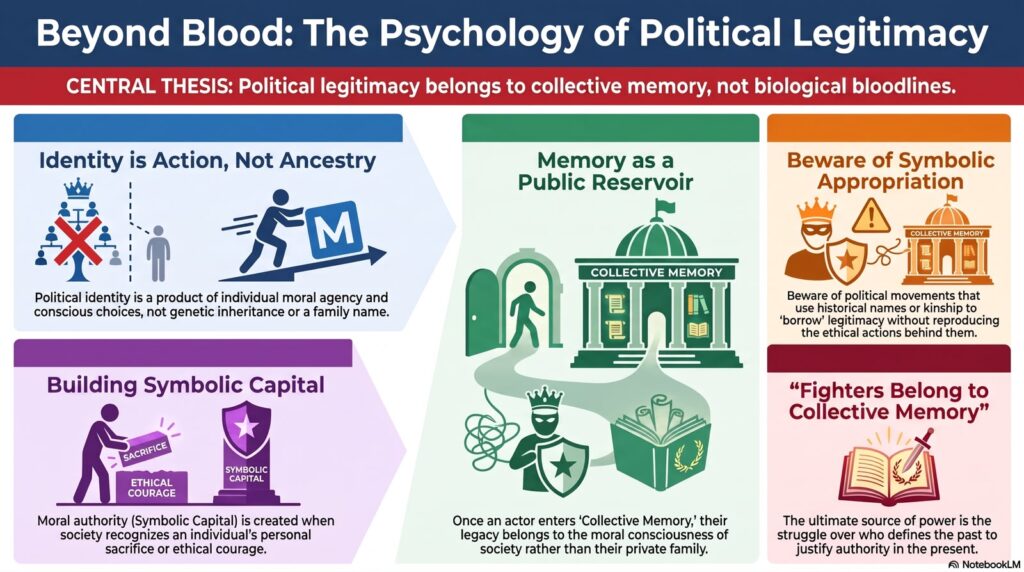
The article further argues that symbolic capital cannot be inherited through biological descent. Political legitimacy does not pass from one generation to another through family lineage but emerges through morally consequential action that is recognized by society and incorporated into its collective memory. Consequently, historical actors who become symbols of freedom, justice, or resistance gradually cease to belong exclusively to their families and instead become part of a society’s shared moral and historical consciousness.
Although illustrated through contemporary debates within Iranian political discourse, the proposed framework is intended to extend beyond a single national context. The Responsibility–Memory Model of Political Legitimacy offers a broader analytical perspective for understanding how political actors seek legitimacy through historical narratives, symbolic appropriation, and struggles over collective memory in both democratic and authoritarian settings.
Keywords
Political Psychology; Political Legitimacy; Collective Memory; Symbolic Capital; Individual Responsibility; Moral Agency; Political Identity; Pierre Bourdieu; Maurice Halbwachs; Social Identity; Historical Memory; Authoritarianism.
Introduction
Political conflict is waged not only over the future but also over competing interpretations of the past. Political actors struggle not merely for institutional power but for the authority to define history, identify legitimate heroes, reinterpret historical defeats, and shape the collective memory through which societies understand themselves. Consequently, historical memory is far more than a repository of past events. It constitutes one of the principal psychological foundations upon which political legitimacy is constructed, maintained, and contested.
No political order derives legitimacy exclusively from its contemporary policies or institutional performance. Every regime, movement, or political project seeks to present itself as the legitimate continuation of a historical tradition that society already recognizes as morally meaningful. In doing so, political actors attempt to establish continuity between their present claims and a selectively reconstructed past. Historical narratives therefore become political resources, and collective memory becomes an arena of competition over legitimacy.
Every society preserves within its historical consciousness individuals whose significance extends well beyond their private lives. Political dissidents, resistance figures, prisoners of conscience, intellectuals, and those who have sacrificed personal freedom or life itself for collective ideals gradually acquire meanings that transcend biography. Their names become more than personal identities; they evolve into symbols of shared ethical values and accumulate what Pierre Bourdieu describes as symbolic capital—forms of social recognition that generate authority, legitimacy, and moral credibility.
Recent developments within contemporary Iranian political discourse provide a useful illustration of this broader phenomenon. Public attention has increasingly been directed toward highly publicized meetings between members of the Pahlavi political movement and relatives of historical opponents of the former monarchy. The political significance of these encounters lies less in the personal choices of the individuals involved than in the symbolic function these relationships perform. When biological descent becomes a political symbol, fundamental questions emerge. Can the historical legitimacy of a political actor be inherited in the same way as a family name? Does kinship itself confer political authority? If political identity is not hereditary, why do political movements invest considerable effort in emphasizing familial connections to historically recognized figures?
This article is not concerned with judging the political choices of particular individuals. Every person possesses the moral and political right to revise convictions, redefine commitments, and pursue an independent political path. The focus of this study is instead directed toward the broader psychological mechanism through which familial relationships become instruments for producing or transferring political legitimacy.
To address this question, the article develops an interdisciplinary framework situated at the intersection of political psychology, sociology, and memory studies. Three interconnected concepts constitute the foundation of the analysis: individual responsibility, symbolic capital, and collective memory. Although these concepts originate in distinct intellectual traditions, together they illuminate the psychological processes through which political legitimacy is socially constructed.
The discussion proceeds in four stages. First, it demonstrates that political identity is not biologically inherited but emerges through processes of moral agency, socialization, and individual choice. Second, it examines how ethically significant action becomes transformed into symbolic capital through collective social recognition. Third, it explores how symbolic capital is preserved through collective memory and thereby detached from exclusive familial ownership. Finally, it integrates these concepts into a broader political psychological model explaining why struggles over historical memory are fundamentally struggles over political legitimacy.
The central thesis of this article is straightforward yet consequential. Political legitimacy is not transmitted through biological inheritance. Rather, it emerges through the interaction of individual responsibility, symbolic capital, and collective memory. From this perspective, attempts to derive political legitimacy from family lineage, or to appropriate the symbolic legacy of historical figures without reproducing the ethical foundations upon which that legacy rests, represent efforts to reshape the psychological mechanisms through which legitimacy itself is socially recognized.
Theoretical Framework and the Responsibility–Memory Model of Political Legitimacy
Political legitimacy has traditionally been examined through institutional, legal, and normative perspectives. Classical political theory has largely associated legitimacy with constitutional authority, electoral representation, or the lawful exercise of political power. Although these perspectives remain indispensable, they explain only part of the phenomenon. They often overlook the psychological and symbolic processes through which societies come to recognize certain political actors, historical narratives, and institutions as morally legitimate.
This article argues that political legitimacy is not solely an institutional achievement but also a psychological and cultural construction. It emerges through the interaction between individual action, social recognition, historical memory, and collective meaning. Understanding this process requires bringing together insights from political psychology, sociology, and memory studies.
The analytical framework developed here rests upon three complementary theoretical traditions.
The first is Pierre Bourdieu’s theory of symbolic capital. Bourdieu demonstrated that power extends beyond economic resources or political institutions. Social recognition, prestige, moral authority, and public credibility constitute forms of capital capable of generating influence independently of material resources. Symbolic capital derives its effectiveness not from coercion but from collective recognition. It exists because society acknowledges particular actions, individuals, or institutions as worthy of respect and legitimacy.
Within the present framework, symbolic capital is understood as the accumulated moral authority produced through ethically significant political action. Individuals who endure imprisonment, persecution, exile, or even death in defense of principles such as freedom, justice, or human dignity often acquire symbolic capital because society interprets their sacrifices as morally meaningful. Their legitimacy is therefore neither inherited nor self-proclaimed; it is socially constructed through recognition.
The second theoretical foundation derives from Maurice Halbwachs’ concept of collective memory. Halbwachs argued that memory should not be understood merely as an individual cognitive process. Rather, societies actively reconstruct the past according to present social frameworks. Historical memory is therefore a collective phenomenon through which communities continually reinterpret their shared experience.
From this perspective, historical actors remain politically influential not because of their biographies alone but because subsequent generations continue to incorporate them into collective narratives of identity, justice, and political meaning. Collective memory preserves symbolic capital across generations, transforming individual lives into enduring components of a society’s moral consciousness.
This perspective is further enriched by Jan Assmann’s distinction between communicative memory and cultural memory. Whereas communicative memory survives primarily through living generations, cultural memory becomes institutionalized through education, public commemorations, literature, monuments, archives, and other symbolic practices. Political legitimacy frequently depends upon this transition from individual remembrance to durable cultural memory.
The third theoretical foundation emerges from contemporary political psychology and social identity theory. Research in social psychology consistently demonstrates that political identities are neither biologically inherited nor permanently fixed. Rather, they develop through processes of socialization, personal experience, group identification, moral reflection, and continuous identity reconstruction.
Social Identity Theory, developed by Henri Tajfel and John Turner, illustrates how individuals construct their identities through membership in social groups while simultaneously retaining the capacity to redefine those identities across changing historical and social contexts. Likewise, Albert Bandura’s work on moral agency emphasizes that individuals remain responsible for their own ethical choices irrespective of inherited social positions or family backgrounds. Political identity, therefore, is fundamentally a product of agency rather than ancestry.
Taken together, these theoretical traditions suggest that political legitimacy cannot be explained through heredity or lineage. Biological descent may establish family relationships, but it cannot generate symbolic authority. Moral legitimacy arises only when individuals become socially recognized for actions that embody values collectively regarded as ethically significant.
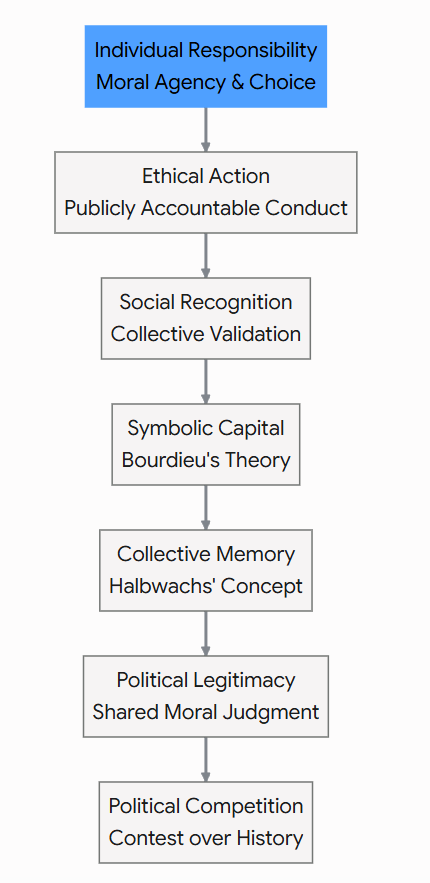
Building upon these perspectives, this article proposes a unified analytical framework: the Responsibility–Memory Model of Political Legitimacy. Rather than treating individual responsibility, symbolic capital, and collective memory as separate concepts, the model understands them as successive stages within a single social process.
Political legitimacy begins with individual responsibility. Individuals freely choose actions for which they assume moral accountability. When these actions become socially recognized as expressions of courage, justice, or ethical commitment, they generate symbolic capital. Over time, symbolic capital is preserved, interpreted, and transmitted through collective memory, where it becomes incorporated into the historical identity of a community. Finally, political actors seeking legitimacy frequently attempt to establish symbolic continuity with these collectively remembered figures and narratives. Consequently, competition over historical memory becomes competition over political legitimacy itself.
The model may be summarized as follows:
Figure 1. The Responsibility–Memory Model of Political Legitimacy
This framework carries implications extending well beyond the contemporary Iranian case. Political movements across democratic and authoritarian contexts alike seek to establish legitimacy through appeals to historical memory. They invoke national founders, revolutionary leaders, resistance figures, religious authorities, or victims of political repression because these individuals possess symbolic capital already embedded within collective memory.
Accordingly, struggles over historical interpretation should not be understood merely as debates about history. They are contests over one of the most valuable political resources available: legitimacy. Whoever succeeds in persuading society that they embody the moral continuity of a respected historical tradition gains access to symbolic resources that cannot be produced through institutional authority alone.
The Responsibility–Memory Model proposed here therefore offers more than an interpretation of a particular political episode. It provides a general conceptual framework for understanding how political legitimacy is generated, preserved, and contested through the dynamic interaction of individual agency, symbolic capital, and collective memory across diverse political and historical settings.
Individual Responsibility: Why Political Identity Is Not Inherited
One of the oldest assumptions in human societies is that identity follows lineage. In everyday life, this intuition appears almost self-evident. Children inherit language, cultural traditions, social habits, and many of the values transmitted within their families. Yet when this ordinary observation is extended into the political realm, it becomes one of the most persistent cognitive errors in political judgment. Family lineage gradually substitutes for individual responsibility, and biological descent begins to replace political action as the basis of evaluation.
Political psychology suggests that this tendency is rooted in the architecture of human cognition rather than in historical reality. Faced with an overwhelmingly complex social world, the human mind constantly seeks shortcuts that simplify interpretation. It categorizes people into recognizable groups, attributes common characteristics to those groups, and then extends those characteristics to individual members. These cognitive heuristics facilitate rapid judgments under conditions of uncertainty, but they also create systematic distortions. In politics, such distortions can profoundly shape public perceptions of legitimacy, authority, and responsibility.
One manifestation of this process is what psychologists describe as psychological essentialism. Essentialism refers to the tendency to perceive personal characteristics as fixed, inherent, and transmissible across generations. Moral integrity, political conviction, authoritarian tendencies, courage, or betrayal may unconsciously be treated as though they were inherited biological traits rather than products of lived experience and ethical choice. Under this assumption, political virtues appear to flow through bloodlines much like physical characteristics.
Contemporary psychological research offers a fundamentally different account. Studies in developmental psychology, social psychology, and identity formation consistently demonstrate that political identity is not genetically determined. Rather, it emerges through an ongoing interaction among personal experience, socialization, education, historical circumstances, interpersonal relationships, and conscious reflection. Political identity is therefore neither static nor predetermined; it is continuously constructed and reconstructed throughout life.
Individuals raised within the same household frequently illustrate this principle. Sharing parents, language, socioeconomic conditions, and cultural traditions does not guarantee shared political convictions. Siblings often develop markedly different ideological commitments, align themselves with opposing political movements, or interpret the same historical events in fundamentally different ways. Their common ancestry provides neither a sufficient nor a necessary explanation for their political identities.
Social Identity Theory, developed by Henri Tajfel and John Turner, reinforces this understanding. Human beings construct their identities through participation in multiple social groups whose relative importance changes across time and context. Political affiliation represents only one among many dimensions of identity, and individuals repeatedly renegotiate these affiliations throughout their lives. New experiences, changing historical conditions, moral crises, and evolving social relationships all contribute to the continual reconstruction of political identity.
Equally important is the concept of moral agency. Individuals are not passive recipients of inherited political identities. They possess the capacity to evaluate traditions critically, reject inherited beliefs, adopt new commitments, and redefine their own ethical positions. Political identity is therefore best understood as an expression of agency rather than ancestry. Responsibility belongs to the individual who acts, not to the family from which that individual descends.
This distinction has profound implications for democratic political thought. Democracies presume that citizens are judged according to their own actions rather than their family origins. Political legitimacy is grounded in accountability, not genealogy. If legitimacy were inherited biologically, democratic politics would gradually collapse into a system governed by dynastic privilege and hereditary status. Individuals would be evaluated less by their conduct than by their surnames, and citizenship itself would become subordinated to lineage.
Political psychology therefore requires a clear distinction between biological identity and moral identity. Biology explains kinship; it does not explain political legitimacy. Human beings may inherit genetic characteristics from their parents, but they do not inherit moral authority, intellectual achievement, political integrity, or ethical responsibility. These emerge only through conscious action, public accountability, and social recognition.
The same principle applies equally to positive and negative political evaluations. The child of an authoritarian ruler bears no automatic responsibility for the crimes of a parent. Likewise, the child of a celebrated dissident or resistance figure acquires no automatic share in that individual’s moral authority. To assume otherwise is to confuse genealogy with responsibility and inheritance with legitimacy.
This distinction becomes especially significant whenever political movements invoke family relationships as sources of political credibility. Kinship may explain personal biography, but it cannot establish political legitimacy. Democratic legitimacy rests upon actions that individuals themselves choose to undertake and for which they themselves assume responsibility.
Consequently, no individual becomes politically legitimate simply by virtue of carrying a historically respected family name. Nor does any individual become politically illegitimate solely because of familial association with controversial historical actors. Political legitimacy is generated neither through inheritance nor through biological continuity. It arises through individual responsibility exercised in the public sphere.
At this point, however, a deeper question emerges. If political legitimacy cannot be inherited, why do certain historical figures continue to command extraordinary moral authority decades, or even centuries, after their deaths? Why do their names continue to evoke trust, admiration, and political credibility across generations? And why do political movements repeatedly seek symbolic association with such figures?
The answer lies in a form of social power that extends beyond individual responsibility alone. Moral action, once recognized collectively, becomes transformed into symbolic capital: a durable source of authority whose influence persists long after the individual actor has disappeared. It is to this transformation that we now turn.
Symbolic Capital: How Political Legitimacy Is Produced
If political identity cannot be inherited through biological descent, another question immediately follows: why do certain individuals continue to exercise political influence long after their deaths? Why do some historical names continue to evoke trust, admiration, and moral authority across generations, while countless others gradually disappear from public consciousness? And why do political movements repeatedly seek symbolic association with such figures?
The answer lies in what Pierre Bourdieu conceptualized as symbolic capital. Among Bourdieu’s most significant contributions to sociology was the recognition that power cannot be reduced to economic wealth, military force, or formal political authority. Human societies recognize additional forms of capital that are equally capable of shaping social and political relations. Prestige, honor, credibility, public trust, and moral authority all function as resources that can influence political life. These resources constitute symbolic capital.
Unlike economic capital, symbolic capital cannot be accumulated simply through possession. It exists only insofar as it is collectively recognized. Its value depends not upon ownership but upon social acknowledgment. Symbolic capital is therefore relational rather than material. It derives its power from the fact that others recognize certain individuals, actions, or institutions as morally legitimate.
From the perspective of political psychology, symbolic capital may be understood as socially accumulated moral credibility. It emerges when a society interprets an individual’s actions as expressions of values it considers ethically significant. A political prisoner who refuses to renounce deeply held convictions, an intellectual who challenges authoritarian rule despite personal risk, or an activist who sacrifices personal safety in defense of justice may gradually acquire symbolic authority because society attributes moral meaning to those actions.
The crucial point is that symbolic capital is produced through action, not through ancestry. It is the consequence of publicly recognized responsibility. Individuals become symbols because their conduct comes to embody values that transcend their private lives. Their authority is therefore not self-generated but socially constituted. Society confers symbolic capital through recognition, remembrance, and moral evaluation.
This distinction explains why symbolic capital cannot be inherited. Biological descent may transfer a surname, family history, or personal possessions, but it cannot automatically transfer the moral significance that society has attached to another person’s actions. Symbolic capital remains inseparable from the ethical choices through which it was originally created.
This observation also helps explain why symbolic capital becomes one of the most valuable resources in political competition. Political movements do not compete only for votes, institutions, or public office. They also compete for moral credibility. Associating oneself with respected historical figures offers access to symbolic resources that would otherwise require decades of political action to acquire independently.
Consequently, nearly every political tradition seeks continuity with a morally recognized past. Revolutionary movements invoke earlier revolutions. Democratic movements appeal to historical defenders of liberty. Nationalist movements celebrate founding figures. Religious movements refer to sacred traditions. Governments commemorate national heroes. Opposition movements honor political prisoners and victims of repression. Although their ideological orientations differ, they all engage in similar symbolic practices because they understand that legitimacy depends not only upon present performance but also upon perceived historical continuity.
At this point, however, it becomes necessary to distinguish between historical continuity and symbolic appropriation.
Historical continuity exists when a political movement genuinely extends the ethical principles, political commitments, and practical responsibilities embodied by an earlier tradition. In such cases, symbolic capital is reproduced through consistent action. Legitimacy emerges because society recognizes continuity not merely in rhetoric but in conduct.
Symbolic appropriation represents a fundamentally different process. Here, political actors attempt to acquire legitimacy without reproducing the actions through which symbolic capital was originally generated. Instead of earning credibility through ethical responsibility, they seek association with already recognized symbols. Historical names, photographs, commemorations, and even familial relationships become instruments through which existing symbolic capital is redirected toward contemporary political projects.
Political psychology helps explain why such strategies can be effective. Human cognition naturally associates symbols with meanings. Once an individual has become firmly established within collective memory as a representation of courage, sacrifice, or justice, subsequent associations with that individual’s name may evoke similar emotional responses. These associations often operate automatically, without requiring careful analytical evaluation. The symbolic authority attached to one figure may therefore become partially transferred to another through repeated psychological association.
This process may be described as symbolic transfer of legitimacy. Importantly, such transfer occurs within public perception rather than through any actual inheritance of moral authority. It depends upon cognitive association, not ethical continuity.
Recognizing this distinction fundamentally changes the nature of the debate surrounding descendants of historically significant political actors. The central issue is not whether children or relatives possess the right to choose political positions different from those of their parents or ancestors. Such freedom follows directly from the principle of individual responsibility established in the previous chapter. Every individual possesses the right to define an independent political identity.
The critical question arises only when biological relationships themselves become presented as sources of political legitimacy. When kinship begins to substitute for political action, symbolic capital becomes detached from the ethical conduct that originally created it. The public is encouraged to perceive continuity where continuity may not actually exist.
At this point another distinction becomes equally important: the distinction between private inheritance and public recognition.
Families unquestionably inherit personal belongings, correspondence, photographs, diaries, and intimate memories. These are private forms of inheritance arising from biological and familial relationships. Symbolic capital, however, belongs to an entirely different category. It does not originate within the family and therefore cannot remain its exclusive possession. Because symbolic capital is produced through collective social recognition, it belongs to the moral community that generated that recognition.
Neither descendants nor political organizations can legitimately claim exclusive ownership over symbolic capital simply because they possess biological or institutional proximity to its original bearer. Its continued existence depends upon society’s ongoing recognition of the ethical significance of the historical actions from which it emerged.
This observation carries an important implication for political legitimacy. Whenever a political project relies more heavily upon historical names, symbolic associations, or family lineage than upon its own demonstrated ethical commitments and political practice, an obvious question arises. Is the movement reproducing symbolic capital through its own conduct, or is it attempting to borrow legitimacy produced by others?
Movements possessing substantial independent legitimacy rarely require symbolic borrowing. Their own actions generate public recognition. By contrast, movements lacking sufficient symbolic capital often seek credibility through historical association.
Ultimately, symbolic capital differs fundamentally from every material form of capital. Wealth may be transferred through inheritance, institutions may be transferred through succession, and political office may be transferred through constitutional procedures. Symbolic capital follows none of these rules. It can only be regenerated through ethically meaningful action capable of earning fresh social recognition.
Historical legitimacy, therefore, remains inseparable from responsibility. It belongs not to lineage but to conduct; not to inheritance but to action.
Yet even symbolic capital cannot endure indefinitely on its own. Recognition requires preservation. Moral authority survives only as long as societies continue to remember the actions from which it originated. This observation leads to the next stage of the present model.
If symbolic capital is created through responsible action, where is it preserved across generations?
The answer lies in the concept that Maurice Halbwachs placed at the center of memory studies: collective memory. It is collective memory that transforms symbolic capital from temporary public recognition into enduring historical legitimacy.
Collective Memory: Why Symbolic Capital Cannot Survive Without Memory
Unlike economic capital, symbolic capital possesses no material existence. It cannot be deposited in a bank, safeguarded in a vault, or legally transferred through inheritance. Its existence depends entirely upon social recognition. Once society ceases to recognize the moral significance of an individual’s actions, symbolic capital gradually dissolves. Its durability therefore depends upon a medium capable of preserving meaning across generations. That medium is collective memory.
This observation brings together the complementary contributions of Pierre Bourdieu and Maurice Halbwachs. Bourdieu explains how symbolic authority is created through social recognition, but he leaves open an equally important question: How does symbolic authority endure long after the original actor has disappeared? Halbwachs provides the missing answer. Symbolic capital survives because societies continually reconstruct and preserve the past through collective memory.
Collective memory should not be understood simply as the accumulation of individual recollections. Halbwachs argued that memory is fundamentally social. Individuals remember within social frameworks that determine what is remembered, what is forgotten, and how historical events are interpreted. Every society continually reconstructs its past according to the needs, values, and concerns of the present. Memory is therefore not a passive archive of historical facts but an active process through which communities define their own identities.
From this perspective, symbolic capital exists only insofar as it remains embedded within a society’s collective memory. Ethical action may generate symbolic authority, but collective memory transforms that authority into a durable historical resource. Without memory, symbolic capital inevitably fades into historical obscurity.
The distinction becomes clearer when we compare fame with historical significance.
Many individuals achieve extraordinary public visibility during their lifetimes. They become celebrities, influential public figures, or political leaders whose names dominate contemporary discourse. Yet many of these figures disappear from public consciousness within a generation. Their visibility proved temporary because it never became integrated into the moral memory of society.
By contrast, other individuals continue to influence political and moral imagination decades or even centuries after their deaths. Their enduring presence cannot be explained merely by historical importance. Rather, society has incorporated them into its shared understanding of justice, resistance, sacrifice, or human dignity. Their lives have become part of the moral vocabulary through which later generations interpret both the past and the present.
Political psychology regards this transformation as one of the most significant processes in the construction of collective identity. Once individuals become incorporated into collective memory, they no longer function merely as historical persons. They become symbolic reference points through which societies interpret contemporary political questions. Their biographies become secondary to the ethical meanings they represent.
At this stage, another distinction becomes essential: the distinction between family memory and collective memory.
Family memory preserves intimate knowledge. It remembers personal conversations, private relationships, habits, emotions, correspondence, photographs, and experiences shared among relatives. These memories possess profound emotional significance, yet they remain fundamentally private.
Collective memory performs a different function. It preserves not the intimate details of individual lives but their historical meaning. Society does not remember historical actors primarily because of their private personalities, but because of what they came to represent within a shared moral narrative. A political prisoner’s daily routines may remain known only to family members, but the prisoner’s resistance, sacrifice, or moral courage becomes part of collective memory because society recognizes broader ethical significance in those experiences.
This distinction has important implications for political legitimacy.
Families may legitimately preserve personal memories, documents, or private archives. They may inherit letters, manuscripts, photographs, or other personal belongings. Yet they cannot claim exclusive ownership over the historical meaning of an individual whose actions have entered collective memory. Historical significance no longer belongs exclusively to descendants because it has become incorporated into the moral consciousness of society itself.
Similarly, governments, political parties, or ideological movements cannot legitimately claim ownership over collective memory. Although political institutions frequently attempt to shape historical narratives through education, commemorations, monuments, museums, or official ceremonies, collective memory ultimately remains a social rather than an institutional phenomenon. It emerges through ongoing dialogue among generations rather than through unilateral political authority.
This explains why struggles over memory occupy such a central place within political life. Political actors rarely compete only over present policies. They also compete over historical interpretation because control over historical meaning influences contemporary legitimacy. Whoever succeeds in defining the meaning of the past acquires significant influence over how society evaluates political authority in the present.
From this perspective, attempts to derive political legitimacy from biological relationships acquire a broader significance. The issue is no longer the personal freedom of descendants to adopt independent political positions. Such freedom remains fully compatible with the principles of individual responsibility discussed earlier. Rather, the issue concerns the symbolic use of kinship itself as a mechanism for reshaping collective memory.
When familial relationships become instruments for political legitimacy, political actors are no longer engaging solely with living individuals. They are intervening in the collective memory through which society understands its own moral history. The symbolic capital accumulated through another person’s ethical action becomes recontextualized within a new political narrative. The contest is therefore not simply over contemporary political allegiance but over the interpretation of historical meaning itself.
Collective memory consequently performs a dual function. It preserves symbolic capital while simultaneously protecting it from exclusive private ownership. Once historical actors become embedded within collective memory, they cease to belong solely to their biological families. They become part of a society’s shared moral inheritance.
This observation brings us back to the central proposition of this article.
Political dissidents, resistance figures, prisoners of conscience, and those who sacrifice personal freedom or life in defense of ethical principles ultimately transcend biological lineage. Their enduring significance lies not in shared ancestry but in the values they come to embody for later generations. Society remembers them not because of who their descendants happen to be, but because their actions continue to illuminate collective understandings of justice, freedom, dignity, and moral responsibility.
The title of this article therefore acquires its full theoretical meaning:
Political fighters do not belong to blood; they belong to collective memory.
This statement should not be interpreted as diminishing the importance of families or denying the emotional bonds connecting descendants to their ancestors. Rather, it recognizes that historical significance changes the relationship between the individual and society. Families preserve private lives; collective memory preserves historical meaning.
Yet collective memory itself does not exist independently of political struggle. Precisely because it serves as one of the principal repositories of symbolic capital, it becomes an object of continual political contestation. Political movements, governments, and competing historical narratives all seek to reinterpret, appropriate, institutionalize, or redefine collective memory in order to strengthen their own claims to legitimacy.
The next chapter examines this final stage of the Responsibility–Memory Model by asking a broader question: Why does political power consistently seek to shape collective memory, and what does this reveal about the psychological foundations of political legitimacy?
The Political Psychology of Legitimacy: Why Power Seeks to Appropriate Memory
The preceding sections have argued that political legitimacy is neither biologically inherited nor produced solely through institutional authority. Individual responsibility gives rise to symbolic capital; symbolic capital is preserved through collective memory; and collective memory becomes one of the principal psychological foundations upon which political legitimacy rests. A final question nevertheless remains: Why do political actors devote so much effort to controlling historical memory?
The answer lies in the nature of legitimacy itself.
Political power may be acquired through force, wealth, or institutional control. Legitimacy, however, cannot. Coercion may compel obedience, but it cannot generate voluntary recognition. Institutions may regulate behavior, but they cannot by themselves create moral authority. Legitimacy emerges only when individuals come to believe that political authority possesses a justified claim to govern. It is therefore, before anything else, a psychological phenomenon.
From the perspective of political psychology, legitimacy is not simply a constitutional status or a legal principle. It is a shared cognitive and moral judgment. Citizens perceive political authority as legitimate when they believe it reflects values that they collectively recognize as historically meaningful and ethically justified. Consequently, legitimacy is constructed not only through institutions but also through narratives, symbols, historical interpretations, and collective identities.
This insight explains why nearly every political order, regardless of ideology, invests heavily in historical memory. Monarchies, republics, revolutionary governments, nationalist movements, liberal democracies, authoritarian regimes, and religious states all seek to establish continuity with a morally recognized past. They celebrate founding figures, commemorate historical victories, honor national heroes, institutionalize public rituals, and preserve particular historical narratives because they understand that political authority requires symbolic foundations as well as institutional ones.
The differences among political systems therefore lie not in whether they employ history but in which history they choose to remember and how they choose to interpret it.
Historical memory is never politically neutral. Every society remembers selectively. Some events become central to national identity, while others gradually fade into silence. Certain individuals are celebrated as heroes, others marginalized, and still others actively erased from public memory. These choices are rarely accidental. They reflect ongoing struggles over the moral foundations upon which political legitimacy is built.
Political legitimacy, therefore, depends not only upon governing the present but also upon shaping interpretations of the past.
This observation allows us to integrate the three concepts developed throughout this article into a single explanatory sequence.
If individual responsibility is ignored, political legitimacy becomes reduced to hereditary entitlement. Individuals are evaluated according to ancestry rather than action, and democratic accountability gives way to dynastic logic.
If symbolic capital is ignored, it becomes impossible to explain why certain historical figures continue to influence political life decades after their deaths. Their continuing authority cannot be understood solely through institutional analysis because it derives from accumulated moral recognition rather than formal political office.
If collective memory is ignored, it becomes equally impossible to explain why political actors devote such enormous resources to monuments, museums, school curricula, commemorative ceremonies, public rituals, historical narratives, and symbolic performances. These practices are not peripheral to politics. They are among the principal mechanisms through which legitimacy is continually reproduced.
The Responsibility–Memory Model proposed in this article therefore identifies political legitimacy as the outcome of an interconnected psychological process.
Individual responsibility generates morally meaningful action.
Morally meaningful action acquires symbolic capital through collective social recognition.
Symbolic capital becomes stabilized within collective memory.
Collective memory subsequently functions as one of the principal reservoirs from which political legitimacy is continuously drawn.
This model also explains why political actors frequently seek association with historically respected individuals. Such efforts should not automatically be interpreted as sincere expressions of historical continuity. They may instead represent attempts to access symbolic capital accumulated through the actions of others. Historical names, images, commemorations, family relationships, and public ceremonies become mechanisms through which political legitimacy is psychologically transferred, contested, or reconstructed.
This distinction is particularly important in democratic societies. Critical reinterpretation of history is an essential component of intellectual freedom. Every generation possesses both the right and the responsibility to revisit historical narratives, challenge established interpretations and reassess inherited assumptions. Such critical engagement strengthens rather than weakens collective memory.
Symbolic appropriation, however, represents something fundamentally different. It occurs when historical memory is employed not primarily to deepen historical understanding but to transfer moral credibility to contemporary political projects without reproducing the ethical commitments through which that credibility was originally established. In such circumstances, history functions less as an object of inquiry than as a resource for legitimacy.
Political psychology helps clarify why this strategy can be remarkably effective. Human beings rarely evaluate political legitimacy solely through rational comparison of competing policy proposals. They rely extensively upon symbols, narratives, moral exemplars, and historical analogies that simplify complex political judgments. Memory therefore functions as a cognitive framework through which present political realities acquire meaning.
Precisely because collective memory serves this psychological function, it remains vulnerable to political manipulation. States may revise textbooks, redesign museums, rename streets, alter commemorative practices, or emphasize particular historical episodes while minimizing others. Political movements may selectively invoke historical figures whose symbolic authority appears useful for present purposes. Yet despite these efforts, collective memory can never be entirely controlled. Unlike official history, collective memory remains distributed across social institutions, cultural traditions, public discourse, and intergenerational communication.
Power may influence memory, but it cannot fully determine the moral judgments through which societies remember their past.
Ultimately, this observation reveals the profound relationship between memory and legitimacy. Political authority seeks historical continuity because continuity provides moral credibility. Historical narratives become politically valuable because they connect present claims to recognized ethical traditions. The struggle over memory is therefore never simply about yesterday. It is fundamentally about who possesses the moral authority to govern today and who may legitimately claim to represent tomorrow.
The political psychology of legitimacy thus arrives at a broader conclusion. Every society continuously negotiates the relationship between its past and its future. Collective memory constitutes the bridge connecting the two. Those who shape the meaning of the past influence the boundaries of political legitimacy in the present. For this reason, conflicts over historical memory are not peripheral to political life. They are among its most enduring and consequential dimensions.
The Responsibility–Memory Model proposed in this article seeks to illuminate precisely this process. It suggests that legitimacy cannot be understood exclusively through institutions, ideology, or legal authority. It must also be understood as a psychological achievement grounded in ethical action, symbolic recognition, and the collective memory through which societies preserve the moral significance of their own histories.
Conclusion
This article has argued that political legitimacy cannot be adequately understood through institutional, legal, or ideological perspectives alone. While these approaches illuminate important dimensions of political authority, they often overlook the psychological and symbolic mechanisms through which legitimacy is socially constructed, preserved, and contested over time. By integrating insights from political psychology, sociology, and memory studies, this study has proposed a conceptual framework that explains legitimacy as the outcome of a dynamic relationship among individual responsibility, symbolic capital, and collective memory.
The analysis began with the principle of individual responsibility. Political legitimacy does not originate in family lineage, biological inheritance, or genealogical continuity. It originates in human agency. Individuals become politically significant through the ethical choices they make, the responsibilities they assume, and the consequences they willingly bear. Political identity, therefore, is not inherited but constructed. Every individual stands before history on the basis of personal action rather than ancestral affiliation.
From this foundation emerges symbolic capital. Morally consequential action acquires political significance only when society collectively recognizes its ethical value. Acts of courage, resistance, sacrifice, intellectual integrity, or public responsibility gradually become invested with symbolic authority because they embody values that transcend individual biography. Symbolic capital is therefore neither a private possession nor a hereditary asset. It is a socially constituted form of moral credibility whose authority derives from collective recognition rather than biological descent.
Yet symbolic capital alone cannot explain historical continuity. Its endurance depends upon collective memory. Collective memory transforms ethically significant action into an enduring component of a society’s historical consciousness. Through this process, historical actors gradually cease to exist merely as private individuals. They become symbolic reference points through which later generations interpret justice, freedom, dignity, and political responsibility. Families may preserve private memories, but the historical meaning of these individuals belongs to the broader community that continues to recognize their moral significance.
Taken together, these three concepts form a single explanatory sequence rather than three independent theoretical propositions. Individual responsibility generates symbolic capital; symbolic capital is preserved through collective memory; and collective memory becomes one of the principal psychological foundations of political legitimacy. This sequence constitutes what this article has termed the Responsibility–Memory Model of Political Legitimacy.
The implications of this model extend well beyond the empirical illustrations discussed throughout the paper. Political competition should not be understood solely as a contest over institutions, elections, or governmental authority. It is equally a contest over symbolic resources embedded within historical memory. Political actors continuously seek to establish continuity with morally respected traditions because they recognize that legitimacy depends as much upon historical credibility as upon present political performance.
From this perspective, the political appropriation of historical memory represents more than a rhetorical strategy. It reflects an attempt to access symbolic capital generated through the ethical actions of others. Historical names, public commemorations, national heroes, resistance figures, and even biological relationships may all become instruments through which political legitimacy is claimed, negotiated, or contested. The crucial issue, however, is not whether historical memory is invoked, but whether such invocation reflects genuine ethical continuity or merely symbolic appropriation.
This distinction also clarifies the relationship between biological inheritance and historical inheritance. Biological inheritance transmits genes, family names, and personal relationships. Historical inheritance transmits meaning. The latter cannot be inherited automatically because meaning is reproduced only through ethical commitment, public responsibility, and continued participation in the moral traditions from which symbolic capital originally emerged. Consequently, no individual inherits political legitimacy simply through ancestry, just as no individual inherits moral authority independently of personal action.
The broader contribution of this article lies in its effort to shift the analysis of legitimacy from institutions alone toward the psychological processes through which societies recognize, preserve, and reproduce moral authority. Legitimacy is not simply granted by constitutions, elections, or formal political procedures. Nor is it reducible to coercive power or ideological persuasion. It is continuously reconstructed within the shared symbolic universe through which societies remember their past and evaluate their present.
This perspective also carries broader implications for democratic political life. Democratic societies require more than free elections or constitutional safeguards. They require a healthy collective memory capable of distinguishing historical understanding from symbolic appropriation, ethical continuity from inherited privilege, and responsible political action from merely inherited identity. A democratic political culture depends upon remembering historical actors for what they did rather than for whom they were related to. When genealogy begins to replace responsibility, legitimacy itself becomes vulnerable to distortion.
Ultimately, the Responsibility–Memory Model suggests that political legitimacy is inseparable from moral agency. Ethical action creates symbolic authority. Collective memory preserves that authority. Political legitimacy emerges where both remain socially recognized. Power may attempt to reinterpret history, reshape public narratives, or appropriate historical symbols, but it cannot permanently substitute inherited lineage for ethical responsibility. The moral foundations of legitimacy remain anchored in action rather than ancestry.
The central proposition of this article may therefore be summarized in a single sequence:
Individual responsibility gives rise to symbolic capital.
Symbolic capital endures through collective memory.
Collective memory constitutes one of the deepest psychological foundations of political legitimacy.
This proposition also illuminates the broader relationship between history and politics. Political struggles are never confined to the present because every claim to authority implicitly invokes a particular understanding of the past. Competing interpretations of history are therefore simultaneously competing claims to legitimacy. To shape collective memory is, in many respects, to shape the moral boundaries within which future political authority will be judged.
The argument developed throughout this article therefore culminates in a broader philosophical observation. Human beings leave behind more than biological descendants. Through ethically significant action, they leave moral legacies that societies may choose to remember, reinterpret, or contest. Once these legacies become incorporated into collective memory, they cease to belong exclusively to families or private lineages. They become part of the shared historical consciousness through which societies define themselves.
For this reason, the central claim of this article is neither rhetorical nor metaphorical. It expresses the fundamental distinction between biological inheritance and historical meaning:
Political fighters do not belong to blood; they belong to collective memory.
Their legacy is neither the private property of their descendants nor a symbolic resource to be appropriated by competing political projects. It belongs to the historical consciousness of the society whose moral imagination they helped shape. History is not written by genes, nor is legitimacy inherited through lineage. Both are created through ethical action, preserved by collective memory, and ultimately judged by the enduring moral conscience of society.
Theoretical Contribution
This article contributes to the interdisciplinary literature on political legitimacy by proposing a novel conceptual framework that integrates three bodies of scholarship that have largely developed independently: political psychology, Pierre Bourdieu’s theory of symbolic capital, and Maurice Halbwachs’ theory of collective memory. While each of these traditions has generated substantial theoretical insight, relatively little attention has been devoted to explaining how they interact to produce and sustain political legitimacy.
The principal theoretical contribution of this study is the Responsibility–Memory Model of Political Legitimacy. Rather than treating individual responsibility, symbolic capital, and collective memory as separate explanatory concepts, the model conceptualizes them as successive stages within a single psychological and social process.
The model argues that political legitimacy originates in individual moral agency. Politically meaningful actions performed under conditions of ethical responsibility generate social recognition, which is subsequently transformed into symbolic capital. Symbolic capital, however, is inherently fragile unless it becomes embedded within collective memory, where it is preserved, interpreted, and transmitted across generations. Once incorporated into collective memory, symbolic capital becomes one of the principal psychological resources through which political legitimacy is continuously constructed, contested, and reproduced.
By emphasizing this sequential relationship, the article advances a broader understanding of legitimacy that extends beyond institutional, legal, or procedural explanations. It suggests that legitimacy is not merely a function of constitutional authority, electoral outcomes, or governmental performance. Rather, legitimacy also depends upon the collective recognition of morally significant action and the preservation of that recognition within a society’s historical consciousness.
A second contribution of the article lies in its distinction between biological inheritance and historical inheritance. Whereas biological inheritance transmits genealogy and kinship, historical inheritance transmits meaning. Political legitimacy cannot be inherited through bloodlines because symbolic capital is created through ethical action rather than biological descent. Consequently, descendants may inherit family relationships, personal archives, and private memories, but they do not automatically inherit the political legitimacy generated by the actions of previous generations.
The article further contributes to scholarship on memory politics by distinguishing between historical continuity and symbolic appropriation. Historical continuity exists when political actors reproduce the ethical commitments and responsibilities that originally generated symbolic capital. Symbolic appropriation, by contrast, occurs when political legitimacy is sought through association with already established historical symbols without reproducing the moral practices from which their authority emerged. This distinction provides a conceptual tool for analyzing political struggles over historical memory across diverse political contexts.
Although contemporary Iranian political discourse serves as the empirical point of departure for the present analysis, the proposed framework is intentionally broader in scope. The Responsibility–Memory Model is designed as a general analytical framework applicable to democratic societies, authoritarian regimes, post-authoritarian transitions, revolutionary movements, national liberation struggles, and processes of transitional justice. Wherever political actors compete over historical narratives, symbolic authority, and collective memory, the model offers a framework for understanding the psychological foundations of political legitimacy.
Finally, this article seeks to contribute to the growing dialogue between political psychology and memory studies by demonstrating that collective memory should not be understood merely as a repository of historical narratives. It also functions as one of the principal psychological infrastructures through which societies recognize moral authority and evaluate political legitimacy. Political conflicts over memory are therefore not simply disputes about the interpretation of history; they are fundamentally struggles over the moral foundations of political authority itself.
For these reasons, the Responsibility–Memory Model of Political Legitimacy proposed in this article is intended not merely as an interpretation of a particular political episode, but as a conceptual framework for future interdisciplinary research on political legitimacy, collective memory, symbolic power, identity formation, and the psychological dynamics of democratic and authoritarian politics.
References
Alexander, J. C. (2004). Toward a theory of cultural trauma. In J. C. Alexander, R. Eyerman, B. Giesen, N. J. Smelser, & P. Sztompka (Eds.), Cultural Trauma and Collective Identity (pp. 1–30). University of California Press.
Arendt, H. (1963). On Revolution. Viking Press.
Arendt, H. (1970). On Violence. Harcourt Brace Jovanovich.
Assmann, A. (2011). Cultural Memory and Western Civilization: Functions, Media, Archives. Cambridge University Press.
Assmann, J. (1995). Collective memory and cultural identity. New German Critique, 65, 125–133.
Bandura, A. (1999). Moral disengagement in the perpetration of inhumanities. Personality and Social Psychology Review, 3(3), 193–209.
Bandura, A. (2001). Social cognitive theory: An agentic perspective. Annual Review of Psychology, 52, 1–26.
Beetham, D. (2013). The Legitimation of Power (2nd ed.). Palgrave Macmillan.
Berger, P. L., & Luckmann, T. (1966). The Social Construction of Reality. Anchor Books.
Bourdieu, P. (1984). Distinction: A Social Critique of the Judgement of Taste. Harvard University Press.
Bourdieu, P. (1986). The forms of capital. In J. Richardson (Ed.), Handbook of Theory and Research for the Sociology of Education (pp. 241–258). Greenwood Press.
Bourdieu, P. (1990). The Logic of Practice. Stanford University Press.
Bourdieu, P. (1991). Language and Symbolic Power. Harvard University Press.
Connerton, P. (1989). How Societies Remember. Cambridge University Press.
Erikson, E. H. (1968). Identity: Youth and Crisis. W. W. Norton.
Giddens, A. (1991). Modernity and Self-Identity. Stanford University Press.
Halbwachs, M. (1992). On Collective Memory. (L. A. Coser, Ed. & Trans.). University of Chicago Press. (Original work published 1950)
Haidt, J. (2012). The Righteous Mind: Why Good People Are Divided by Politics and Religion. Pantheon Books.
Hobsbawm, E., & Ranger, T. (Eds.). (1983). The Invention of Tradition. Cambridge University Press.
Jost, J. T. (2020). A Theory of System Justification. Harvard University Press.
Nora, P. (1989). Between memory and history: Les lieux de mémoire. Representations, 26, 7–24.
Olick, J. K. (1999). Collective memory: The two cultures. Sociological Theory, 17(3), 333–348.
Olick, J. K., Vinitzky-Seroussi, V., & Levy, D. (Eds.). (2011). The Collective Memory Reader. Oxford University Press.
Ricoeur, P. (2004). Memory, History, Forgetting. University of Chicago Press.
Taylor, C. (1994). The politics of recognition. In A. Gutmann (Ed.), Multiculturalism: Examining the Politics of Recognition (pp. 25–73). Princeton University Press.
Tajfel, H. (1981). Human Groups and Social Categories. Cambridge University Press.
Tajfel, H., & Turner, J. C. (1986). The social identity theory of intergroup behavior. In S. Worchel & W. Austin (Eds.), Psychology of Intergroup Relations (2nd ed., pp. 7–24). Nelson-Hall.
Turner, J. C., Hogg, M. A., Oakes, P. J., Reicher, S. D., & Wetherell, M. S. (1987). Rediscovering the Social Group: A Self-Categorization Theory. Basil Blackwell.
Weber, M. (1978). Economy and Society (G. Roth & C. Wittich, Eds.). University of California Press.