By Kazem Kazerounian, Professor and Dean of College of Engineering (2012-24) , University of Connecticut
“Facts do not cease to exist because they are ignored.” — Aldous Huxley
1. Introduction
The claim that the People’s Mojahedin Organization of Iran, MEK, collaborated with Saddam Hussein during the Iran–Iraq War did not emerge as a neutral historical conclusion. It originated as an instrument of political demonization. From the earliest years of the Islamic Republic, the accusation was deployed to delegitimize and isolate its most organized domestic opponent. Over time, repetition transformed accusation into assumption. However, political utility is not historical evidence.
This article proceeds in two parts. Sections 2 through 4 establish the factual record. They examine the chronology of the war, the internal repression that preceded relocation, the geopolitical reality of Iraqi Kurdistan, and the evidentiary basis of the collaboration allegation. These sections rely on documented events, archival logic, and verifiable developments.
Sections 5 and 6 move into the realm of political and moral argument. They address the legitimacy of continuing the war after Khorramshahr, the ethical dilemma of resistance from foreign soil, and the broader function of demonization in authoritarian systems.
The debate ultimately turns on a question that has rarely been asked directly. After the liberation of Khorramshahr in 1982, when the defensive objective of the war had largely been achieved, what course of action best served Iran’s national interest? Continue the war under the regime’s slogan jang, jang ta piroozi (war until victory)? Seek a negotiated peace with Iraq despite the political costs of dealing with Saddam Hussein? Oppose the continuation of the war but remain politically silent? Or actively challenge the regime that chose to prolong the conflict?
Any evaluation of the MEK’s subsequent choices must begin with this historical moment.
Only by separating documentation from rhetoric can the collaboration allegation be evaluated with seriousness.
Factual Record (sections 2 through 3)
2. From Defense to Transformation: A Chronology, 1980–1988
Understanding the MEK’s role requires tracing two simultaneous escalations: the external war with Iraq and the regime’s internal war against dissent. The MEK’s eventual presence on the border, and later in Iraq, did not arise from opportunism. It followed systematic repression and the narrowing of political space inside Iran.
1980–1981: Defense of Sovereignty
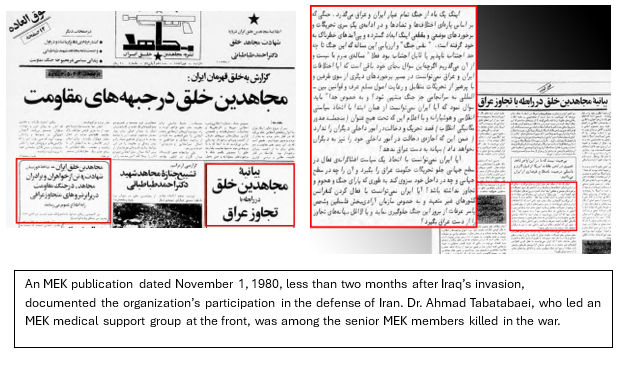
On September 22, 1980, Iraq invaded Iran and occupied sovereign territory. At that moment, the MEK was still operating legally and peacefully inside the country. It publicly condemned the invasion and mobilized members for national defense. Several were killed fighting on the front lines.
An MEK publication dated November 1, 1980, documented its participation in defending Iranian territory.
A number of MEK members who had volunteered to defend Iran during the early months of the invasion were captured by Iraqi forces and held as prisoners of war until the end of the conflict. Had the organization been allied with Iraq during that period, it is difficult to explain why those fighters remained in Iraqi captivity throughout the war.
At the outset, the MEK stood within the framework of national defense. The organization attempted to sustain a dual posture: resisting foreign invasion while maintaining domestic political activity in Tehran.
June 1981: The Internal Rupture
On June 20, 1981, the regime violently suppressed a massive peaceful MEK demonstration (500,000 strong) in Tehran (with only over 3M population). Countess arrests and executions followed. Even prior to that rupture, MEK members had been expelled from war fronts and some arrested. Political space was systematically closed.
The shift into armed resistance was not ideological escalation. It was structural compulsion. The rupture was domestic in origin.
July 1981: Establishment of the National Council of Resistance of Iran (NCRI)
Following the June 20, 1981 crackdown and the closure of all legal political space inside Iran, the National Council of Resistance of Iran was established on July 20, 1981. Conceived as a broad political coalition, the NCRI aimed to unify opposition forces around a platform for regime change and democratic transition. Shortly thereafter, its leadership relocated abroad, with Paris becoming its principal political base during the early 1980s.
1982: Khorramshahr and the Legitimacy Threshold
In May 1982, Iranian forces liberated Khorramshahr and expelled Iraqi troops from major portions of occupied territory. The original defensive objective of the war had been achieved. Iraq signaled readiness for a ceasefire and, through Saudi mediation, indicated willingness to discuss war reparations. Instead of consolidating peace, the regime crossed into Iraqi territory. The slogan “The path to Ghods passes through Baghdad” reflected the ideological shift. What had begun as defense evolved into expansion.
The MEK declared that continuation after Khorramshahr had lost its national legitimacy and now served regime preservation and ideological ambition.
1982: The MEK-Iraq Peace Proposal
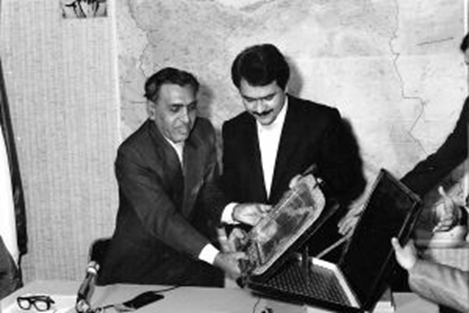
Following the liberation of Khorramshahr and Iraq’s indication of readiness for a ceasefire, Massoud Rajavi signed a formal peace framework with the Government of Iraq in 1982. The initiative reflected the MEK’s position that the defensive phase of the war had ended and that negotiated peace was both possible and necessary. Its advocacy for ceasefire stood in contrast to the regime’s decision to escalate the war beyond Iranian territory. Iraqi government’s approval and signature on this agreement demonstrated that peace was achievable.
| The provisions of the peace plan were as follows: 1- Immediate declaration of a ceasefire between all forces of the two countries on land, air, and sea. 2- Establishment of a ceasefire and withdrawal monitoring commission under the supervision of a mutually agreed authority or the Secretary-General of the United Nations. 3- Withdrawal of the forces of both countries to the internationally recognized borders as specified in the protocols concerning the re-demarcation of the Iran–Iraq land boundary and the protocol concerning the determination of the river boundary between Iran and Iraq, along with the annexed maps and aerial survey documents signed by both parties. The timetable for withdrawal to these international borders would be determined by the ceasefire monitoring commission prior to the declaration of the ceasefire. 4- Exchange of all prisoners of war within a maximum of three months after the ceasefire declaration, in accordance with international regulations and under the supervision of the International Committee of the Red Cross. 5- Referral of the issue of war damages to the International Court of Justice in The Hague to determine responsibility for damages and the method of compensation owed to Iran. The Court’s ruling would be binding. 6- Commitment by both parties to facilitate the return of refugees and displaced persons of the two countries through the declaration of general amnesty and guarantees of their financial and personal security. 7- Conclusion of a final peace treaty between the two countries based on full respect for national sovereignty and independence, territorial integrity, non-interference in each other’s internal affairs, good neighborliness, and the inviolability of borders. |
1982: Campaign to Halt Civilian Bombing
As the war escalated into reciprocal bombardment of civilian areas, Massoud Rajavi called on the Iraqi government to halt attacks on non-combatants. The NCRI and the MEK launched international efforts to stop the bombing of cities. Iraq suspended strikes on civilians. In April 1985, Rajavi received an international humanitarian award in India in recognition of efforts to stop the bombing of civilian populations.
1983–1985: The Border Phase
Driven underground at home, MEK units relocated to Kurdish regions along the Iran–Iraq border. These areas were politically fragmented and populated by multiple opposition forces.
June 1986: Relocation to Iraq
The relocation from France occurred in the context of intense diplomatic pressure from Tehran. At the time, several French nationals were being held hostage by pro-Iranian militias in Lebanon, and French authorities imposed restrictions on Iranian opposition groups as part of broader negotiations with the Iranian government. Shortly after, in June 1986, Rajavi departed France for Iraq, several French hostages were released.
1986–1987: Strategic Reorientation and the NLA
The National Liberation Army was established with a clear and explicit objective: the overthrow of the Iranian regime. Its strategic reasoning was straightforward. If the regime’s survival depended on prolonging the war and sustaining militarization, then confronting and destabilizing its war apparatus became a strategic necessity.
1988: The Endgame
In 1988, after cumulative military and economic pressure, including NLA operations such as Chelcheragh, Iran accepted UN Security Council Resolution 598.
Khomeini described acceptance as “drinking the chalice of poison.” Former IRGC commander Javad Mansouri later acknowledged that the war had enabled suppression of internal opposition and consolidated regime authority.
The war ended not because its ideological aims were fulfilled, but because continuation had become unsustainable. Over the full course of the war from 1980 to 1988, the human and material cost was immense. Estimates vary, but the conflict over a million dead and many more wounded on both sides. Iranian casualties alone are often cited in the hundreds of thousands, with a generation marked by physical injury, psychological trauma, and social disruption. Entire cities in border provinces such as Khorramshahr, Abadan, and Dezful were devastated. Industrial infrastructure, oil installations, ports, transportation networks, and agricultural lands suffered extensive damage. Millions were displaced internally, and vast national resources were diverted from reconstruction and development into sustaining the war effort. By the time the ceasefire was accepted in 1988, the war had reshaped Iran’s economy, militarized its political structure, and left deep social scars that would endure long after the guns fell silent.
Post 2000: Judicial and Archival Scrutiny of the Allegations
The absence of credible evidence supporting the allegation of MEK collaboration with Saddam Hussein has also been tested through formal legal and institutional review. During the 2000s, courts in France, the United Kingdom, the European Union, and the United States examined extensive intelligence records while reviewing the designation of the MEK and its affiliated organizations as terrorist entities. In each case, the allegations failed to withstand judicial scrutiny. One of the most comprehensive inquiries occurred in France, where authorities conducted an eight-year anti-terrorism investigation beginning in 2003. When the case was dismissed in 2011, the investigative magistrate concluded that no evidence had been found indicating that the MEK had targeted civilians or engaged in acts that would invalidate the principle of legitimate resistance to tyranny. Similar legal proceedings in the United Kingdom, the European Union, and the United States likewise resulted in the removal of the organization from terrorist designation lists after courts determined that the evidentiary basis presented by governments was insufficient.
The fall of Saddam Hussein in 2003 created an additional opportunity to verify the collaboration claim through direct examination of Iraqi state archives. United States forces captured extensive records from Iraq’s military and intelligence services, which were subsequently analyzed by U.S. authorities and later by Iraqi governments politically aligned with Tehran. If the MEK had functioned as a subordinate force within Iraq’s war apparatus, documentary traces would almost certainly have appeared in these materials. Yet no such evidence has ever been produced. Reviews of the captured files uncovered no documentation indicating that MEK units operated within Iraqi command structures, received operational directives from Iraqi military authorities, or participated in joint battlefield operations with Iraqi forces during the Iran–Iraq War.
1990-91 and 2003: Subsequent Tests of Organizational Independence
Later developments also provide an indirect test of the collaboration claim. If the MEK had functioned as a subordinate or proxy force of the Iraqi state during the 1980–1988 war, such a relationship would likely have manifested itself in later regional conflicts involving Iraq. Yet during both the 1990–1991 Gulf War and the 2003 U.S.-led invasion of Iraq, the organization declared neutrality despite operating from Iraqi territory. In neither conflict did the MEK participate in military operations on behalf of the Iraqi government.
These episodes are significant because proxy relationships typically impose operational obligations during periods of host-state conflict. The absence of such participation reinforces the conclusion that the MEK’s presence in Iraq did not constitute military subordination or integration within Iraqi command structures, but rather reflected the strategic choice of an Iranian opposition movement seeking to confront the Tehran regime from beyond its borders.
3. The Border Reality: A Shared Opposition Landscape
Between 1982 and 1986, the Kurdish regions of Iraq along the Iran–Iraq border became a staging ground for a broad spectrum of Iranian opposition forces. These mountainous areas were not centralized Iraqi military zones under direct Baghdad command. They were politically fragmented frontier spaces shaped by Kurdish autonomy movements, insurgent networks, and regional rivalries.
The dominant actors in these areas were Kurdish organizations. The Kurdistan Democratic Party of Iran (KDPI) exercised substantial local influence and pursued Kurdish autonomy. Komala operated armed units with a Marxist-Leninist orientation, while Sazman Khabat also maintained a presence in the region. Alongside them were Iranian leftist groups such as the Organization of Iranian People’s Fedai Guerrillas (Minority faction) and Paykar, both of which established bases in the mountains after being driven underground inside Iran. Remnants of the Tudeh Party also fled to these areas following the regime’s crackdown in 1983.
Nationalist and monarchist factions were active in Iraqi territory as well. The National Movement of the Iranian Resistance (NAMIR), associated with former Prime Minister Shapour Bakhtiar, operated radio broadcasting facilities and intelligence networks from Iraqi soil. General Gholam Ali Oveissi’s monarchist organization, composed largely of former Imperial officers, attempted to organize a counter-revolutionary structure from Baghdad. The Azadegan Movement, led by General Bahram Aryana, maintained paramilitary units along the border regions. Unlike many of the Kurdish and leftist factions, these nationalist and monarchist groups reportedly received significant logistical and political support from the Iraqi government.
This context is essential. Iraqi Kurdistan during those years was a crowded opposition arena, not a bilateral arrangement between the MEK and Baghdad. Multiple Iranian factions operated from the same terrain after being expelled from political life inside Iran. The MEK was one actor among many. Its presence in that geography reflected political displacement under wartime conditions rather than automatic subordination to Iraqi command.
4. Dissecting the “Collaboration” Allegation
Collaboration implies one of four concrete conditions:
- financial patronage,
- command subordination,
- intelligence integration,
- or coordinated military operations .
If none can be demonstrated, the accusation collapses.
Financial Patronage
No credible document has ever surfaced showing that the MEK functioned as a subsidized mercenary force of the Iraqi state. More than twenty years have passed since the fall of Saddam Hussein. During that time, Iraq’s intelligence and military archives have been accessible to the US authorities in Iraq and then to successive governments in Baghdad, politically aligned with Tehran. Not a single authenticated document, not even a shred of evidence, has emerged demonstrating Iraqi payroll status, financial backing, or institutional subordination.
The MEK has released documentation showing payments for rent, utilities, telecommunications services, and procurement of equipment. It paid for facilities and services received.
The MEK has also published documentation of its purchases of weapons, ammunition, and logistical supplies. These documents, which have been reviewed and validated by judicial authorities, indicate that the organization paid for items such as vehicles, military boots, uniforms, weapons, and other equipment.
Military Subordination and Coordination
No Iraqi military order has been produced placing MEK forces inside Iraqi command. No evidence demonstrates incorporation into Iraqi operational hierarchy.
No documentation shows joint command structures, coordinated operational planning, integrated targeting, or synchronized battlefield directives between the MEK and the Iraqi army.
Military integration leaves documentation, or at the very list human witnesses. None has surfaced in four decades of accusation and two decades of open archives.
Intelligence Integration
No documented archival evidence establishes that the MEK engaged in intelligence collaboration against Iranian civilians. On July 2, 1988, Radio Baghdad aired remarks by Saddam Hussein responding to that charge:
“Among the lies spoken by Khamenei in yesterday’s Friday prayer is that he called the opposition, specifically the Mujahedin-e Khalq who stand against them, mercenaries of Iraq. We have no mercenaries. These are fighting people, and we respect them. They have their own thinking. I say this for the record of history: previously, we asked them for certain information, the kind that could harm their economy or their people, but they refused. When they refused, we respected their position as a political force.”
The Political and Moral Case After Khorramshahr
5. Fight or Not Fight? The Ethical Dilemma
The central moral objection is that operating from Iraqi territory during wartime crossed an ethical boundary. But that objection cannot be examined in isolation. It must be preceded by a more fundamental question: what alternatives remained?
By 1981, peaceful political activity had been eliminated. Demonstrations were answered with gunfire. Tens of thousands were imprisoned or executed. Urban guerrilla operations became unsustainable under pervasive repression. Exile advocacy could not alter internal power structures, particularly as foreign governments, under sustained diplomatic pressure from Tehran, imposed increasing restrictions on the political space available to Iranian opposition movements abroad. The range of viable options narrowed dramatically.
The question, therefore, was no longer whether the political environment was hostile. It was whether organized resistance would continue at all. The strategic choice became stark: withdraw into political marginality, as many ultimately did, or reorganize under new conditions and pursue regime change through the only remaining feasible means.
The MEK’s response was to fight the regime in the only form it judged viable under conditions of total repression.
This decision must also be understood in light of the 1982 turning point. After the liberation of Khorramshahr, continuation of the war ceased to be an unavoidable act of national defense and became a political choice. The turning point of 1982 therefore poses a simple historical question that is rarely asked openly. After the liberation of Khorramshahr, what position did one take?
- Continue the war until victory, as the regime demanded under the slogan jang, jang ta piroozi?
- Seek a negotiated peace with Iraq, even if that meant dealing with Saddam Hussein?
- Oppose the war but remain politically silent?
- Or actively and forcefully resist the regime that had chosen to prolong it?
Every political actor in that period made a choice. Any serious historical evaluation must begin by acknowledging those choices.
Fighting a regime is not identical to fighting a nation. The MEK declared its struggle directed at the Islamic Republic, not at Iran’s territorial integrity. It did not advocate partition or foreign annexation. Its argument was that prolonged war strengthened authoritarian consolidation and deepened domestic repression.
By contrast, those who continued to frame the post-1982 conflict as a purely national and patriotic war, a jang-e melli va mihani, embraced a narrative that insulated the regime from scrutiny. By treating continuation as sacred defense rather than political choice, they helped legitimize a conflict that extended far beyond the recovery of Iranian territory. The result was years of additional casualties, economic devastation, and social trauma. That prolonged destruction did not restore sovereignty. It consolidated Khomeini’s internal authority and reinforced the militarized structure of the state.
There were also those who attempted to occupy a safer middle ground. They declared themselves opposed to war in principle, yet refused to oppose its continuation in practice. They criticized escalation rhetorically while defending the regime’s decision to carry the conflict beyond Iranian borders. This posture allowed them to appear morally cautious while avoiding the political consequences of openly challenging the continuation of the war. Speaking against war in abstraction while legitimizing it in reality did not shorten the conflict. It prolonged it.
Historical actors rarely operate under ideal conditions. They confront constrained choices shaped by repression, war, and narrowing political space. The MEK did not obscure its position or disguise its objectives. It stated openly that it sought regime change. It argued publicly that the war had lost its defensive legitimacy after Khorramshahr. It chose a course of action consistent with that analysis, and it bore the costs of that choice. Its words, its strategy, and the price it paid were aligned.
6. Demonization as Political Warfare
The collaboration allegation must be understood within a broader pattern of state-sponsored demonization. From its earliest years, the Islamic Republic has relied on delegitimizing labels to neutralize opposition. Demonization operates through moral framing rather than evidence and repetition rather than documentation. The “Saddam collaboration” narrative compresses years of shifting political realities into a single image of betrayal. It fuses foreign invasion with internal dissent and transforms political opposition into moral treason.
This campaign has not been confined to Iran’s domestic media environment. Over the past four decades, the Iranian state has also sought to shape international perceptions of the MEK through diplomatic pressure, media influence, and information operations directed at Western audiences. Researchers have documented efforts to encourage journalists, academics, and policy commentators to repeat narratives portraying the organization as extremist, cult-like, or aligned with foreign enemies. In one reported instance, Iran’s embassy in Canada allegedly offered $80,000 to a think-tank director in exchange for labeling the MEK a “cult” in public commentary.
Diplomatic leverage has also played a role. Former officials have noted that Western governments at times faced pressure from Tehran to restrict the activities of the MEK and the National Council of Resistance of Iran as part of broader diplomatic engagement, including negotiations related to regional security and nuclear issues. Through repetition across media, academic, and diplomatic channels, the accusation of “Saddam collaboration” gradually migrated from propaganda into assumed historical fact despite the absence of documentary evidence.
When narrative replaces documentation and repetition replaces evidence, accusation becomes memory. Restoring chronology restores proportion.
7- Conclusion: War, Memory, and Evidence
What remains, therefore, is not a settled historical verdict but a political and moral debate. It concerns the legitimacy of continuing the war after its defensive objective had been fulfilled, and the ethics of resistance under authoritarian repression.
Serious historical inquiry requires clear distinctions: between regime and nation, between geographic presence and structural subordination, between allegation and evidence. The debate over the MEK’s wartime strategy cannot be separated from a larger historical question. After the liberation of Khorramshahr, when the defensive phase of the war had ended, what was the responsible course of action? Continue a war that increasingly served political consolidation rather than national defense, seek peace despite the political costs, or remain silent while the conflict expanded?
History is shaped by the choices people make under such conditions. Narratives may endure, but only evidence establishes truth.
“The truth has no defense against a fool determined to believe a lie.” Mark Twain