Iraj Abedini, Psychologist, Sweden
Organized Killing, Symbolic Violence, and the Collapse of Collective Psyche in Iran
What has unfolded in Iran in January 2026 is neither a “security crackdown” nor a “harsh response to protests.” Based on extensive documentation, recurring patterns, and reports by international human-rights organizations, it is now possible to state with precision that Iranian society is facing a new phase of organized state crime. In this phase, violence is no longer reactive; it is policy.
Reports published by Human Rights Watch and Amnesty International explicitly emphasize that the use of live ammunition against unarmed protesters was neither sporadic nor the result of individual decisions by security forces. It was deliberate, coordinated, and designed at the highest levels of power. The systematic targeting of heads and upper torsos constitutes intent to kill under international law and, from the perspective of political psychology, functions as a message of power.
The message is unmistakable:
“We kill, we terrorize, and we are not accountable.”
Killing as State Policy
The temporal and geographic patterns of repression, the deployment of military-grade weapons, and their synchronization with a nationwide internet blackout demonstrate that the decision to apply lethal force was taken at the highest levels of the state. This is not unfamiliar to Iranian society. The same logic governed the 1980s: street executions, the killing of children without registering their identities, secret burials, and ultimately the mass execution of more than 30,000 political prisoners in 1988.
What we are witnessing today is not a rupture from the past. It is the historical continuation of the same logic of elimination, executed with updated tools and greater impunity.
Internet Shutdown: Engineering Silence and Cognitive Void
According to human-rights reports, the nationwide internet shutdown was not merely censorship. It was a core component of repression, designed to create a cognitive void. In such a condition, society cannot narrate events, provide testimony, or even collectively mourn.
Under these circumstances, contradictory casualty figures, terrifying rumors, and pervasive anxiety proliferate. From the standpoint of trauma psychology, society enters a state of chronic collective hypervigilance: a mode of existence defined by the constant expectation of catastrophe, even in silence.
Body Bags: The Moment Collective Conscience Collapses
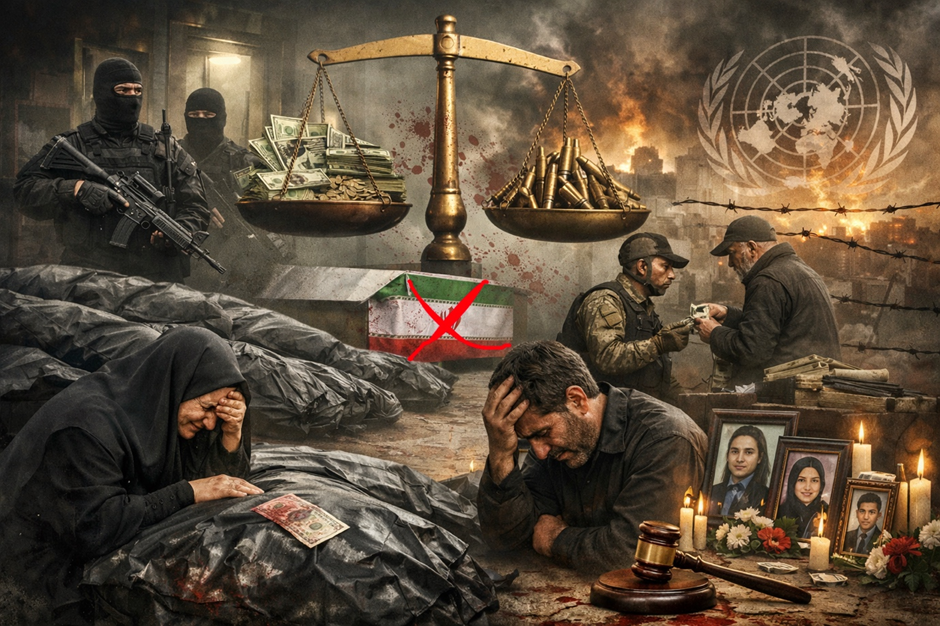
Images from forensic facilities showing hundreds of stacked body bags are not merely evidence of atrocity. They mark the point at which political violence transforms into collective trauma. Families searching for their loved ones among body bags confront not only loss, but humiliation, uncertainty, and terror.
Here, death is not the end of violence. It is the threshold to its next phase.
Bullet Fees and the Economy of Death
A Psychological Formulation of Structural Crime
At this stage, the regime enters a more naked terrain: the economy of death. Demanding “bullet fees” from families of the killed is neither an isolated abuse nor low-level corruption. It is a calculated symbolic act within a coherent logic of domination.
This act produces a complete moral inversion. The killer becomes the creditor; the victim’s family becomes the debtor. Such role reversal is a classic mechanism of symbolic violence in totalitarian systems, aimed not merely at eliminating bodies, but at destroying dignity, meaning, and the possibility of mourning.
From the perspective of trauma psychology, mourning is a fundamental process for restoring psychological coherence at both individual and collective levels. By hostage-taking bodies, threatening secret burials, and extorting money, the regime directly attacks this process. The result is “suspended grief”: frozen trauma that cannot be processed and thus becomes chronic and intergenerational.
Within the economy of death, the murdered body serves three simultaneous functions:
the physical elimination of dissent,
the production of social terror,
and the extortion and humiliation of families.
In this structure, death inaugurates the second phase of psychological torture, marked by imposed shame, learned helplessness, and the collapse of trust in the world.
Historical Continuity: From the 1980s to Today
Bullet fees are the contemporary expression of the same logic that, in the 1980s, erased victims’ names, banned public burials, and forced families into silence and clandestine mourning. The difference lies only in language. Then it was the language of erasure; today it is the language of economics.
The regime performs the same act, with updated vocabulary.
Proxy Forces and the Distortion of Narrative
Alongside domestic repression, the role of regime-adjacent proxy forces abroad, particularly monarchist circles centered around Reza Pahlavi, has been instrumental in distorting the narrative of the protests. Attacks on other opposition groups, appropriation of slogans, manipulated audio overlays, and the construction of false binaries have enabled the regime to securitize protests and later portray victims as “foreign agents” or “external enemies.”
Here, propaganda is not an accessory to violence; it is violence continued by other means.
Final Synthesis
When Death Becomes an Instrument of Power
This is not chaos or a security failure. It is organized symbolic violence.
A shot to the head is a message of power.
Bullet fees are moral inversion.
Hostage-taking of bodies is the destruction of mourning and collective memory.
Internet shutdowns are the engineering of silence.
In this structure, bodies are killed, meaning is confiscated, and fear becomes social order. This is the point at which physical violence transforms into the destruction of collective psyche and social future.
A regime that invoices death is not governing.
It is devastating humanity itself.
And it is precisely here that responsibility crosses national borders.
Address to the International Communit
Silence in the face of this level of organized violence is not neutrality; it is passive complicity. When killing is documented, mourning is confiscated, and death is weaponized, moral and legal responsibility becomes global. The world cannot claim commitment to “human rights” while responding to body bags, bullet fees, and engineered silence with mere “concern.”
What is required now is not neutral statements, but concrete action: effective diplomatic pressure, activation of international accountability mechanisms, support for independent fact-finding, and an end to impunity for perpetrators.
History is recording this moment.
The question is: on which side was the world standing?