Ashraf Zadshir, MD; Clinical Assistant Professor; Scholar and Researcher on HIV/Hepatitis; 2006 California Woman of the Year.
1. Introduction: The Clinical Method as an Analytical Framework
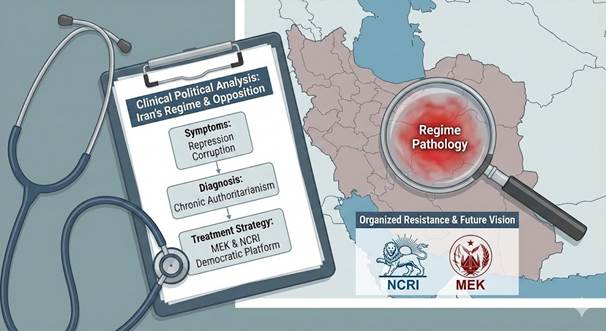
Clinical decision-making proceeds through a disciplined sequence of inquiry: the collection of reliable data, the formulation of differential diagnoses, the testing of hypotheses against empirical findings, and the application of treatments whose effects are continuously monitored and reassessed. Although rooted in medical science, this structured method provides a powerful analytic metaphor for understanding political systems that exhibit persistent forms of dysfunction. Viewed through this lens, authoritarianism may be understood as a chronic social pathology; a systemic disorder that progressively erodes the institutional “organs” of representation, accountability, and pluralism.
This essay adopts the clinical method as its conceptual framework to analyze Iran’s political evolution since 1979. It argues that the main opposition movements Mujahedin-e Khalq (MEK) and the National Council of Resistance of Iran (NCRI) were among the first to articulate a coherent diagnosis of the Iranian regime’s authoritarian trajectory and to propose a long-term “treatment strategy” rooted in democratic principles, institutional reform, and organized resistance.
By applying this model to the case of Iran, the analysis seeks to illuminate not only the pathological nature of the current regime but also the historical significance of those opposition movements that recognized, early on, the structural character of the crisis and articulated a sustained program for political recovery.
2. Applying the Clinical Method to Social Systems: A Therapeutic Metaphor
The clinical model offers a useful framework for political analysis when an authoritarian regime is conceptualized as a patient whose “body” comprises the institutions of the state and whose “symptoms” manifest in repression, coercive control, maladaptive governance, and periodic eruptions of social unrest. Within this metaphor, the clinician’s systematic approach becomes a structured guide for diagnosing and intervening in political pathologies. Each step translates into an analytic stage:
- History Taking – Reconstructing the political history of the regime, identifying the recurrent cycles of repression and resistance, and tracing the accumulation of societal stressors that signal chronic dysfunction.
- Application of Knowledge – Employing established political theory, comparative authoritarianism, and sociological frameworks to interpret observable symptoms and to discern the underlying mechanisms that sustain autocratic control.
- Physical Examination – Assessing the “organs” of the authoritarian body: the security and intelligence apparatuses, the judiciary and bureaucratic instruments of coercion and corruption, the economic networks that enable elite consolidation, and the institutional pathways through which power is exercised and maintained.
- Diagnostic Testing – Gathering empirical evidence—social indicators, protest dynamics, policy outcomes, and institutional behavior—to validate the severity of the regime’s dysfunctions and to identify points of structural vulnerability.
- Diagnostic Formulation – Synthesizing findings to determine the root causes of authoritarian persistence, including entrenched power structures, systemic inequities, ideological imperatives, and the mechanisms that reproduce repression across generations.
- Evaluation and Treatment – Designing a comprehensive strategic plan that functions as the regime’s “therapy.” In this model, political interventions—whether internal mobilization, external pressure, or organizational resistance—operate as forms of medication or corrective procedures aimed at weakening coercive structures, and strengthening civic resilience. A serious opposition program thus becomes a precise therapeutic prescription, tailored to the specific pathologies of the political organism.
In political analysis, these clinical steps correspond to a series of methodological operations:
- examining historical trajectories, tracing the evolution of state–society relations and the consolidation of power;
- interpreting developments through political theory, situating observed patterns within broader frameworks of authoritarianism, revolution, and regime durability;
- assessing state structures, with particular attention to coercive institutions, ideological organs, and administrative mechanisms of control;
- collecting empirical evidence, including protest data, economic indicators, policy outcomes, and institutional behaviors;
- identifying structural drivers, such as ideological imperatives, elite networks, and systemic inequities that sustain authoritarian rule; and
- evaluating short- and long-term strategies or policy interventions, whether pursued by domestic opposition movements, civil society actors, or external stakeholders.
Together, these analytical steps offer a structured template for examining Iran’s post-revolutionary political system and for assessing the actions of opposition forces who attempted, from an early stage, to diagnose and confront the emergence and entrenchment of authoritarian rule.
3. Iran’s Chronic Authoritarianism as a Social Pathology
Since the 1979 revolution, the Iranian regime has displayed many features associated with entrenched authoritarianism, including:
- the consolidation of power within unelected and unaccountable institutions, notably the Office of the Supreme Leader and its patronage networks;
- the systematic suppression of political pluralism, eliminating or co-opting alternative centers of authority;
- severe restrictions on civil and political liberties, enforced through security organs, ideological policing, and legal repression; and
- structural impediments to democratic contestation, embedded in constitutional design, electoral engineering, and institutional guardianship.
Viewing this entrenched order as a chronic social disease foregrounds an essential analytical question: which political actors correctly identified these pathologies at their inception, accurately diagnosed their structural causes, and articulated a coherent, long-duration plan for national recovery?
This inquiry inevitably directs attention to the MEK and the NCRI, the only opposition force that not only recognized the architecture of repression as it was forming, but also developed an ideological and institutional alternative capable of contesting it. Crucially, the MEK advanced—long before it was fashionable or even intelligible in Western discourse—the concept of a democratic Islam grounded in popular sovereignty, gender equality, political pluralism, and the absolute separation of religion and state. This vision stood in direct and explicit contradiction both to the emerging absolutism of Khomeini’s clerical rule and to the authoritarianism later embodied by groups like ISIS.
At a moment when the regime equated political dissent with apostasy and framed absolutist theocracy as divine mandate, the MEK exposed the fallacy by articulating a form of Islam compatible with democracy, individual rights, and peaceful political competition. This was not rhetorical positioning—it reflected a foundational ideological commitment that shaped the movement’s resistance strategy.
The MEK’s historical leader, Massoud Rajavi, captured this contrast with remarkable clarity more than four decades ago:
“The Islam we profess does not condone bloodshed. We have never sought, nor do we welcome confrontation and violence. To explain, allow me to send a message to Khomeini through you… My message is this: If Khomeini is prepared to hold truly free elections, I will return to my homeland immediately. The MEK will lay down their arms to participate in such elections. We do not fear election results, whatever they may be… If Khomeini had allowed half or even a quarter of the freedoms presently enjoyed in France, we would have certainly achieved a democratic victory.”[1]
This position, publicly voiced at a time when the regime still enjoyed revolutionary fervor and international deference, demonstrated not only ideological clarity, but democratic self-confidence. It also highlighted a critical historical truth: the MEK was the first organized force to reject the clerical state on both political and theological grounds, thereby delegitimizing the regime’s core claim to religious authority.
In this sense, the movement did more than oppose authoritarianism—it articulated the intellectual and moral architecture for an Islamic-democratic alternative years before the regime’s abuses became widely recognized. By diagnosing the disease early, identifying its systemic roots, and proposing a structured political remedy, the MEK emerged as the principal and most durable challengers to the theocracy’s authoritarian order.
4. The MEK: Early Diagnosis and Analytical Consistency (1965–1981)
4.1 The MEK’s Foundational Analysis (1965–1979)
Founded in 1965, the Mujahedin-e Khalq (MEK) emerged as the primary and most popular organized opposition movement to offer a systematic, structural critique of the Pahlavi state. Rather than framing political dysfunction solely in terms of monarchical excess or individual misrule, the MEK identified deeper institutional and sociopolitical drivers of authoritarianism. Its early analysis highlighted:
• the concentration of executive power, insulated from public accountability;
• severe restrictions on political freedoms and civic participation;
• the regime’s dependence on foreign patronage, which reinforced domestic unresponsiveness; and
• the systematic repression of dissent, enforced through security and intelligence organs likhe SAVAK.
In 1953, Iran’s democratically elected Prime Minister, Dr. Mohammad Mossadeq, was removed in a coup orchestrated by the United States and the United Kingdom, with active support from elements of the clerical establishment, including Ayatollah Khomeini’s mentor, Ayatollah Abolghassem Khashani. The coup restored the Shah to power and was quickly followed by the establishment of SAVAK, his notorious secret police. These events left a profound and enduring imprint on the Iranian collective consciousness, fostering deep-seated resentment toward foreign powers and a persistent suspicion of external interference in the nation’s sovereignty.
Crucially, the MEK argued that the overthrow of the Shah would not, in itself, eliminate the structural pathologies that produced authoritarian governance. Without institutional safeguards, these conditions, they warned, could reappear in new configurations after the revolution—a prescient assessment that anticipated the emerging dynamics of the post-1979 political order.
4.2 Rajavi’s 1979 Tehran University Speech: A Critical “Clinical Warning”
In a landmark 1979 speech at Tehran University immediately after the revolution, Masoud Rajavi, the MEK’s historical leader, articulated a set of principles grounded in democratic accountability, constitutional restraint, and political pluralism. Speaking at a moment of revolutionary euphoria, he cautioned that the survival of freedom required:
• genuine political pluralism,
• a clear separation of religion and state,
• robust rule of law, and
• inclusive participation across all social constituencies.
Absent these foundations, Rajavi warned, Iran risked reproducing authoritarian structures under a new ideological banner. Among supporters and scholars of the Iranian opposition, this address is often regarded as one of the earliest systematic diagnoses of the post-revolutionary dangers facing the country—a clinical warning issued at the very moment the new order was being constructed.
The MEK’s dispute with Khomeini began in the mid-1970s, well before Khomeini seized state power. While serving a life sentence, Massoud Rajavi identified Khomeini as a reactionary cleric whose vision was incompatible with the democratic and social freedoms that the anti-monarchic movement had struggled to achieve. This principled stance on the absolute necessity of protecting hard-won liberties immediately distinguished the MEK from Khomeini’s emerging authoritarian project.
In one of many seminal addresses, delivered at Tehran University in 1980 and entitled “The Future of the Revolution,” Rajavi declared:
“How fitting that today we are again speaking on freedom at the university, the bastion of freedom. No progress and mobilization for the revolution would be conceivable without guaranteeing freedom for all parties, opinions, and writings. If by freedom we specifically have in mind free and just relationships domestically, independence speaks to the same meaning in our foreign and international relations. We do not accept anything less in the name of Islam. Anything to the contrary would be deviation and regression and nothing more.”[2]
This speech exemplified the MEK’s early articulation of a vision of democratic Islam, rooted in both domestic liberty and national sovereignty, sharply contrasting with Khomeini’s authoritarian, theocratic model.
4.3 The Re-emergence of Dictatorship: A Predicted Recurrence
The MEK consistently argued that the overthrow of the Pahlavi monarchy removed the immediate manifestation of authoritarianism but left its deeper structural pathology intact. In their view, without the establishment of institutional checks, constitutional safeguards, and enforceable guarantees of political pluralism, Iran remained vulnerable to a relapse into autocratic rule, this time reinforced by the more radical and medieval ideology of Islamic fundamentalists. This diagnosis proved strikingly prescient.
The rapid consolidation of clerical authority in the early 1980s, marked by the monopolization of power within unelected organs, the brutal suppression of dissent, and the systematic exclusion of alternative political voices, aligns closely with the trajectory the MEK had warned against. Many contemporary analysts now regard this sequence not as an unforeseen deviation but as a predictable recurrence of authoritarian rule—precisely the relapse the MEK had anticipated in its early assessments.
5. Steadfast Opposition and Enduring Sacrifice
5.1 Repression and Political Costs
As the clerical regime consolidated power, the MEK quickly emerged as one of its primary and most systematically targeted adversaries. This was partly due to the fact that the MEK rejected the regime’s Islamic fundamentalist ideology and introduced a democratic interpretation of Islam that valued freedom and gender equality. Throughout the early 1980s and beyond, the organization faced extensive repression, including mass arrests, extrajudicial executions, enforced disappearances, and widespread exile of its members and supporters. These measures were designed not merely to suppress dissent but to dismantle the organization’s capacity and rapidly growing ideological influence.
Despite these profound human and political costs, the MEK preserved its internal coherence and continued to articulate a structured alternative to clerical rule. Its persistence under extreme repression has become a defining feature of its historical trajectory and a key dimension of its enduring relevance.
5.2 Commitment to a Singular Objective: A Democratic Iran
Over the course of five decades—amid regional upheaval, shifting global alignments, and repeated domestic crises—the MEK and the NCRI have maintained a consistent strategic objective: the creation of a democratic, secular, and pluralistic Iranian republic. This continuity contrasts sharply with other opposition formations that have fragmented, reoriented their priorities, or receded from political activity altogether.
The durability of this objective, and the sustained and intense organizational effort behind it, underscores the MEK and NCRI’s role as long-term proponents of a comprehensive “treatment plan” for Iran’s authoritarian pathology, grounded in people’s sovereignty and the rule of law.
6. Formation and Expansion of the NCRI: A Long-Term Opposition Coalition
6.1 The NCRI as a Coalition (1981–present)
Established in 1981, the NCRI emerged as a broad-based political coalition intended to:
- unify democratic forces across ideological and social lines,
- offer a structured and credible political alternative to clerical rule,
- prevent a post-regime power vacuum that could invite fragmentation or renewed authoritarianism, and
- articulate a clear constitutional and institutional vision for a future democratic republic that rejects both the monarchy and clerical rule.
Over more than four decades, the NCRI has distinguished itself as the only enduring Iranian opposition coalition with stable leadership, institutional continuity, and a formal political program.
6.2 The 10-Point Plan: A Structured Democratic Framework
NCRI President-elect Maryam Rajavi’s 10-Point Plan constitutes one of the most comprehensive and detailed frameworks for post-authoritarian governance advanced by any Iranian opposition movement. The plan centers on:
- free and fair elections with universal suffrage,
- gender equality and the full political participation of women,
- judicial independence and due process protections,
- abolition of the death penalty,
- separation of religion and state,
- a commitment to a non-nuclear Iran, and
- robust protections for human rights, the environment, minority rights, and individual liberties.
Taken together, these principles outline a coherent democratic architecture aimed at preventing the recurrence of authoritarianism and ensuring a peaceful transition to representative governance. The plan’s specificity and institutional clarity further underscore the NCRI’s role as a long-term architect of a future democratic order.
6.3 Diaspora Organization and Transnational Reach
The NCRI and MEK have cultivated an extensive transnational presence, supported by:
- highly active Iranian diaspora communities that serve as hubs of political advocacy and cultural mobilization;
- regular engagement with parliaments and legislative bodies across Europe, North America, and beyond, enabling sustained policy dialogue and international visibility;
- annual international gatherings that convene lawmakers, scholars, human rights advocates, and diaspora representatives; and
- broad alliances with civil society organizations, including human rights networks, women’s rights groups, and democratic movements.
In contrast to episodic or personality-driven initiatives that emerge fleetingly during moments of crisis, the NCRI has developed a durable, institutionalized organizational infrastructure capable of long-term political engagement. Its consistent presence in global democratic forums underscores its role as a sustained, strategically coordinated opposition—not a temporary or reactive movement, but a transnational actor with enduring capacity and reach.
7. Comparative Framework: MEK/NCRI and Alternative Opposition Strategies
7.1 Western Engagement as Symptom Management
For decades, Western policy toward Iran has been shaped by strategies of diplomatic engagement, calibrated sanctions relief, and the expectation that incremental internal “reform” might moderate the regime’s behavior. While often justified as pragmatic, these approaches have been criticized for functioning primarily as forms of symptom management: they sought to mitigate acute crises, nuclear escalation, regional destabilization, or human rights abuses, without addressing the deeper structural drivers of authoritarian entrenchment. As a result, the core institutional architecture of repression remained largely untouched, allowing systemic dysfunction to persist and periodically intensify.
7.2 MEK/NCRI’s Systemic Treatment Strategy
In contrast, data and historical analysis indicate that the MEK/NCRI advanced a comprehensive, long-term strategy aimed at addressing the structural underpinnings of authoritarianism. This approach includes:
- building a broad democratic coalition through the establishment and expansion of the NCRI to over 500 organizations and individuals (more than half are women);
- articulating a detailed governance alternative, most notably in NCRI President-elect Maryam Rajavi’s 10-Point Plan;
- supporting domestic protest and resistance networks, often at substantial human and organizational cost;
- exposing the regime’s nuclear and regional activities, contributing to international oversight (the NCRI was the first to expose the regime’s clandestine nuclear weapons program in August 2002);
- mobilizing the Iranian diaspora as a sustained political and advocacy force; and
- pursuing coordinated international engagement with lawmakers, civil society institutions, and global democratic actors.
This multifaceted strategy functions as a coherent “treatment plan,” rather than as a set of reactive or transient measures shaped by shifting political winds.
7.3 Comparison with Monarchists and Other Movements
From a comparative political perspective, the MEK/NCRI stands out for its:
- organizational longevity, maintained despite repression, exile, and geopolitical shifts;
- clarity and specificity of political program, including constitutional, institutional, and rights-based commitments;
- global grassroots infrastructure, with active diaspora networks and transnational partnerships; and
- consistent analytical framework, rooted in a structural diagnosis of authoritarianism and a defined pathway for democratic transition.
By contrast, monarchist factions and various smaller opposition groups have generally lacked comparable institutional development, policy coherence, or sustained strategic planning. Their mobilization has often been episodic, personality-driven, or constrained by internal fragmentation—limitations that significantly impair their capacity to serve as credible alternatives to the existing political order.
Moreover, confronting an entrenched authoritarian regime requires not only organizational structure but a coherent ideology, a disciplined movement, and a willingness to bear the profound costs associated with political struggle. In this respect, the contrast becomes even more pronounced: the MEK has sustained more than 120,000 sympathizers and members killed since 1981, a level of sacrifice unparalleled among Iranian opposition groups. This cumulative price underscores a depth of commitment and operational resilience that others have not demonstrated, and it highlights the extent to which successful resistance demands durable conviction, not symbolic or episodic engagement.
- Conclusion: A Distinctive Long-Term Contribution to Iran’s Political Future
From a scholarly perspective, the MEK and NCRI constitute one of the most analytically coherent and institutionally durable opposition forces in modern Iranian political history. They were among the earliest actors to identify the structural roots of Iran’s authoritarian trajectory; they have maintained an organized resistance over nearly five decades; they have articulated a detailed governance blueprint; and they have built a transnational network capable of sustained mobilization and political engagement. Their growing visibility, both within Iran and across the global diaspora, further underscores their role as a consequential and enduring political actor.
Within the clinical metaphor employed throughout this study, the MEK/NCRI have functioned as diagnosticians and practitioners who:
- recognized the underlying pathology of authoritarian consolidation;
- warned of its trajectory and likely recurrence even in the immediate aftermath of the 1979 revolution;
- advanced a long-term treatment strategy grounded in institutional transformations, people’s sovereignty, and democratic norms; and
- persisted in implementing this strategy despite extraordinary political repression and significant human cost.
A particularly glaring dimension of this contribution is the movement’s sustained presence inside Iran—operating under severe surveillance, censorship, and risk. Internal resistance networks, known as Resistance Units, have disseminated information, coordinated local initiatives, and preserved channels of communication essential for civic mobilization. Their activities demonstrate not simply ideological persistence but an operational capacity rarely matched by any opposition group in Iranian history.
At the same time, the NCRI’s expansive transnational infrastructure—supported by diaspora communities, parliamentary engagement, and global civil society alliances—has amplified domestic efforts, creating a dual pressure system. This fusion of internal resistance and external advocacy has strengthened the movement’s resilience and broadened its international legitimacy.
The endurance, organizational coherence, ideological clarity, laser-focused leadership, and transnational reach of the MEK/NCRI position them as a unique and influential force in shaping Iran’s future political landscape. In a context where confronting authoritarianism requires disciplined organization, coherent vision, and readiness to bear immense sacrifice, the MEK/NCRI stand out as an opposition movement that has not only diagnosed the systemic “disease” but has persistently advanced—and paid the price for—a comprehensive strategy aimed at democratic transformation.
As Iran edges toward an increasingly uncertain political horizon, the MEK and the NCRI stand not merely as participants in the struggle for change, but as its most organized, battle-tested, and indispensable architects. Their accumulated experience, disciplined program, and sustained nationwide mobilization make them an unavoidable point of reference in any serious examination of Iran’s democratic prospects. No other opposition force possesses comparable institutional depth, ideological clarity, or record of sacrifice. In truth, there is no alternative of equal credibility or consequence.
[1] Massoud Rajavi, interview in L’Unita Paris, January 1, 1984.
[2] Massoud Rajavi, “Future of the Revolution,” speech in Tehran University, January 10, 1980, text published in Mojahed, Vol. 2, no. 19. January 15, 1980.