By FISN Staff, Updated January 2026
The following guidelines ensure clarity, consistency, and scholarly rigor across all academic submissions to the FISN website. Each requirement includes a brief explanation and an illustrative example where helpful.
1. Descriptive Title
Provide a short, impactful title that clearly communicates the purpose of the article. A strong title helps readers immediately understand the focus of the work. It should be concise, direct, and reflect the article’s central theme—without being vague or overly broad. Clear titles also support indexing, professionalism, and discoverability.
Ideal: Principled Resistance and the Path to Democratic Transition in Iran
Not ideal: Some Thoughts on the Situation in Iran (it is overly generic)
2. Abstract and Keywords
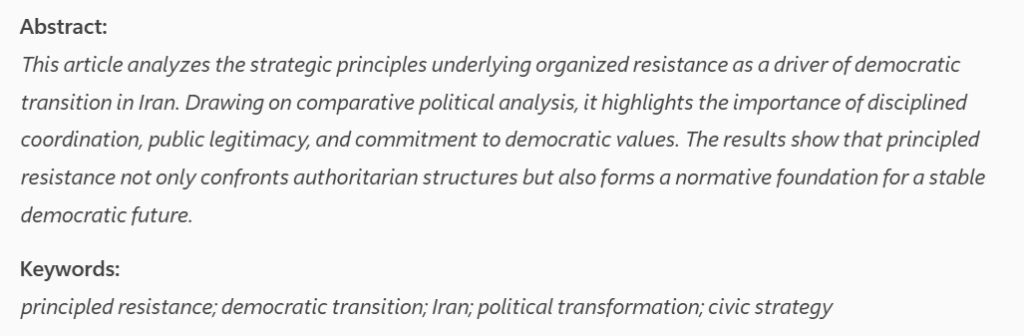
An academic or research‑based submissions should include: A concise abstract (100–200 words) summarizing the central argument, methodology, and key findings and a set of 3–6 keywords reflecting the main themes and functioning as hashtags for indexing.
Abstracts allow readers and editors to understand the core contribution of the article quickly. Keywords improve navigation, searchability, and thematic categorization across the FISN platform. Please see example below:
3. Structured Body with Numbered Sections
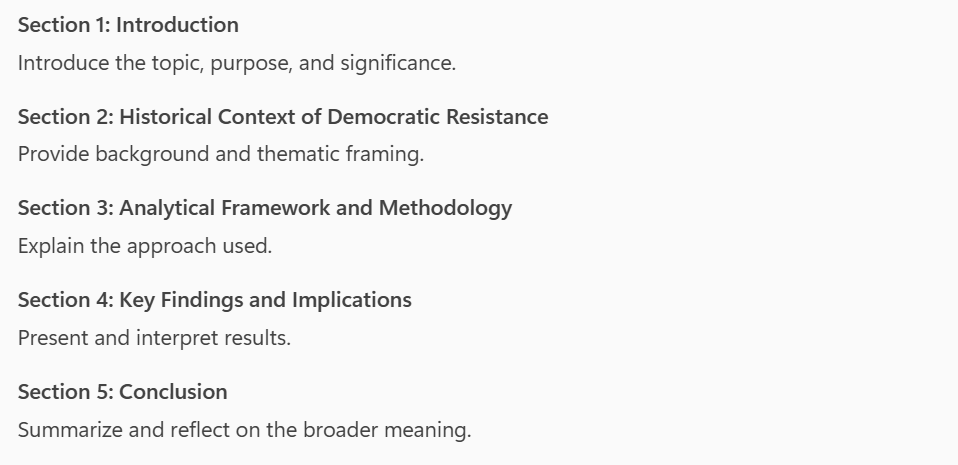
For longer articles, organize the body into numbered sections. Begin with Section 1: Introduction, followed by logically ordered sections that progressively develop the argument. Each section must have a clear, descriptive title.
Numbered sections improve readability and guide the reader through the article’s logical progression. A meaningful introduction establishes purpose and relevance, while subsequent sections deepen the analysis and support the overall argument. An example:
4. Minimal Writing and Formatting Standards
All submissions must follow clear, consistent writing and formatting conventions to ensure readability, professionalism, and alignment with FISN publication standards.
Proper writing mechanics improve the clarity and credibility of each article. Consistent punctuation, capitalization, and paragraph formatting help readers follow the argument without distraction, while also maintaining a uniform appearance across all FISN publications.
Please follow these minimal guidelines:
- Use punctuation marks correctly and consistently
- Use uppercase and lowercase letters consistently
- Leave a blank line between paragraphs: This improves readability, aligns with modern digital publishing conventions, and creates a clean visual structure.
- Avoid overly long paragraphs
5. Summary or Conclusion Section
End the article with a Summary or Conclusion that synthesizes the main points and enumerates key findings. A clear concluding section reinforces the article’s major contributions and ensures readers retain the essential ideas. Listing key findings (in brief statements or bullet points) improves clarity and highlights the article’s significance.
6. References (Simplified APA Style)
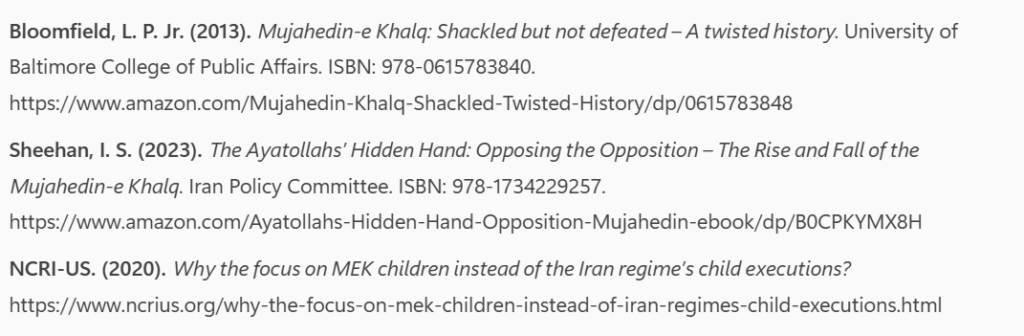
Include a References section listing all sources cited in the text. Use a simplified APA format: first author’s last name followed by the year of publication in parentheses. Additional publication details should be included to ensure traceability. Examples: (Blookmfield, 2013), (Sheehan, 2023), (NCRI-US, 2020).
Uniform reference formatting supports professionalism and clarity. Sufficient details, author, year, title, publisher, and identifiers (ISBN, link), ensure that all sources can be easily located by readers and researchers.
7. Complete and Accurate Reference List
At the end of the article, provide a complete and accurate list of all cited references. Every source must include full publication details and must be readily accessible through a stable source or link.
Accurate references are essential for scholarly credibility. They allow readers to verify claims, explore further, and cite responsibly. Incomplete or inaccessible references undermine trust and academic rigor. For formatting, please see the following APA example.